Flamenco Turns (Vueltas): The Three Types and How to Learn Them
 Part of our guide
How to Learn Flamenco: A Complete Guide for Beginners →
Part of our guide
How to Learn Flamenco: A Complete Guide for Beginners →
Flamenco turns, known in Spanish as vueltas (turns), are among the most striking moments in any baile (dance). A dancer gathers the momentum of the compás (rhythmic cycle), rotates, and arrives back facing the audience with the arms still and the gaze fixed — a small feat of control that looks effortless only because it is not. This guide, part of our broader look at how to learn flamenco, explains what a vuelta is, the three main types classified by axis of rotation, where they come from, and how a beginner can build them safely and well.
What Is a Vuelta in Flamenco?
A vuelta is simply a turn: a rotation of the body around a vertical axis. In flamenco, however, the turn is never a decorative flourish added on top of the dance. It grows out of the compás, resolves within it, and carries the same grounded weight and expressive intent as the footwork and arm movement around it. Understanding the vuelta therefore means understanding not only how the body rotates, but how that rotation stays anchored in posture and rhythm.
What distinguishes one turn from another is chiefly the axis of rotation — the line the body turns around, and the relationship of the torso to that line. It is on this basis that flamenco teachers commonly organize the vueltas into three main types.
The Three Main Types of Flamenco Turns
Classified by axis of rotation, the three principal flamenco turns are the vuelta normal, the vuelta quebrada, and the vuelta de pecho. Each builds on the one before it, which is why they are usually taught in this order.
- Vuelta normal (basic turn) — the foundational turn, a straightforward rotation of the body around its vertical axis. Everything else is a variation on it, so it is the first vuelta a student learns and the one to return to whenever balance or control begins to slip.
- Vuelta quebrada (“broken” turn) — a vuelta normal taken behind, with a twist of the torso. The “break” in the line of the body makes it one of the most recognizable elements in all of flamenco, giving the turn a sculptural, off-axis quality that reads powerfully from the audience.
- Vuelta de pecho (“chest” turn) — a vuelta normal taken in front, again with a twist of the torso. Where the quebrada opens behind, the de pecho leads with the chest, lending the turn a different accent and direction of intent.
The quebrada and the de pecho are, in essence, the basic turn shaped by a twist of the torso in two contrasting directions. This is why a secure vuelta normal is the prerequisite for both: the torso can only articulate cleanly over an axis that is already stable.
The Roots of the Vuelta in the Escuela Bolera
These turns did not originate in flamenco. They derive from the escuela bolera, the Spanish classical dance school whose refined technique predates and runs alongside flamenco. Much as flamenco absorbed rhythms and influences from many sources, it also drew its turning vocabulary from this established classical tradition and reshaped it within its own aesthetic.
The result is that a vuelta in flamenco is recognizably related to its escuela bolera ancestor yet unmistakably flamenco in feeling — grounded rather than airborne, weighted rather than light, and always in service of the compás and the emotional line of the dance. Knowing this lineage helps a student appreciate why flamenco turns prize control and rootedness over elevation.
Ready to put this into practice?
Train with Siudy Garrido through our On-Demand Flamenco Courses — structured, professional flamenco instruction you can start today.
Spotting: The Head Last to Leave, First to Arrive
The single most important technique for executing any vuelta cleanly is spotting. The principle is easy to state and demanding to master: as the body rotates, the head is the last to leave a fixed point and the first to arrive back at it.
In practice, the dancer fixes the eyes on a chosen point at eye level and holds the gaze there as the body begins to turn. At the last possible moment the head whips around, ahead of the body, and the eyes snap back to the same point. This delayed, decisive head movement is what preserves balance and prevents dizziness, allowing a dancer to complete a vuelta — or a series of them — without losing orientation. Without disciplined spotting, even a technically correct turn will wobble.
Postura: Controlled Balance Through the Turn
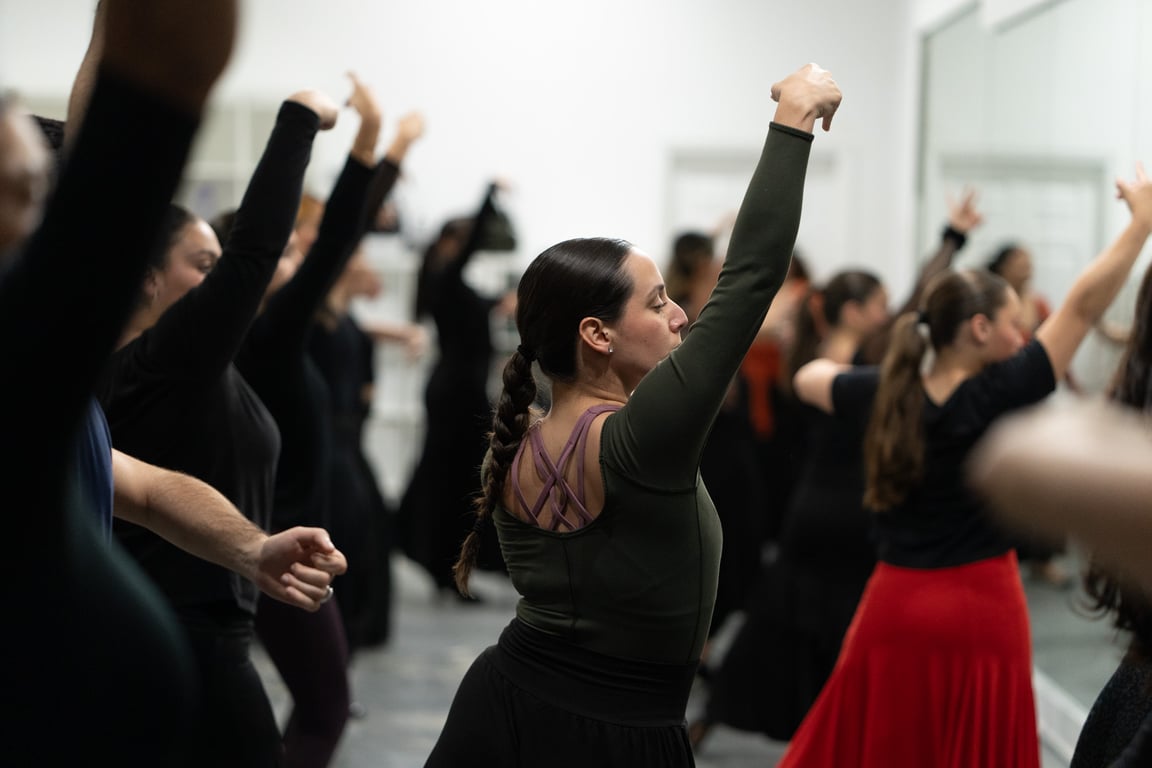
Spotting governs the head; postura (posture) governs everything below it. A vuelta can only stay balanced over a stable axis, and that axis is built from a controlled, grounded postura: a long spine, an open chest, and the weight rooted rather than tipping. The carriage should be proud but never stiff, because a rigid body cannot rotate smoothly and a collapsed one cannot hold its line.
Through the turn, the dancer maintains this vertical alignment so that the rotation happens around a clean axis rather than around a shifting, unstable center. The braceo (arm movement) is coordinated with the turn rather than flung, and the core holds the torso in place — especially in the quebrada and de pecho, where the torso deliberately twists off the axis and must return to it with control. Good posture, in short, is what makes a vuelta look composed rather than improvised. For a fuller treatment of alignment, see our guide to flamenco posture and the body.
A Practical Progression for Beginners
Learning to turn well is a matter of sequence and patience. The following progression reflects the order in which the flamenco turns are typically built, from the ground up.
- Establish the postura first. Before turning at all, find the long spine, open chest, and rooted weight that will become your axis. A turn is only as stable as the posture it rotates around.
- Learn to spot in place. Practice fixing the eyes on a point at eye level and letting the head be last to leave and first to arrive, at first without a full turn. Reliable spotting is the foundation of every vuelta.
- Build the vuelta normal slowly. Combine posture and spotting in a single, unhurried basic turn. Prioritize a clean axis and a controlled arrival over speed; a slow turn done well teaches more than a fast one done poorly.
- Add the torso twist. Once the vuelta normal is secure, introduce the vuelta quebrada and the vuelta de pecho, feeling how the torso breaks behind or leads in front while the axis stays intact.
- Place the turn in compás. Finally, practice the vuelta within the rhythm rather than in isolation, so the turn begins and resolves musically, as it must in a real dance.
Throughout, resist the temptation to chase speed. In flamenco, as with footwork, clarity and control come before velocity; the impressive multiple turns come later, and only on the foundation of a single clean one. If you are still building the basics of movement and rhythm, our guide to flamenco footwork for beginners complements this work, since footwork and turns share the same demand for grounded, controlled balance.
Bringing the Vuelta Into Your Dancing
The vuelta is where posture, rhythm, and spotting meet, which is why it rewards careful, structured study rather than imitation alone. Building the vuelta normal first, then layering the quebrada and de pecho over a stable axis, gives you turns that read as composed and intentional. To study these flamenco turns guided step by step, explore Siudy Garrido's on-demand flamenco classes, and browse the full flamenco blog for more on the technique and tradition behind the dance.
Frequently asked questions
What are the three main types of flamenco turns?
What is spotting in flamenco turns?
Where do flamenco turns come from?
How should a beginner start learning flamenco turns?
Start dancing flamenco with Siudy Garrido
On-Demand Flamenco Courses — professional instruction, at your pace.
Explore Courses →