Dancing With the Manton: The Flamenco Shawl Explained
 Part of our guide
How to Learn Flamenco: A Complete Guide for Beginners →
Part of our guide
How to Learn Flamenco: A Complete Guide for Beginners →
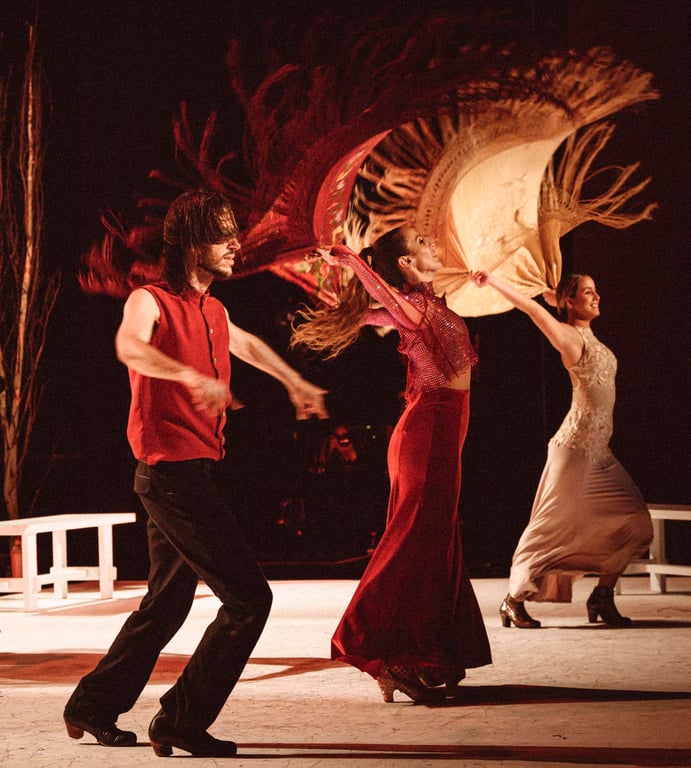
Few images capture the drama of flamenco as completely as a dancer wrapped in a great fringed shawl, sending it arcing overhead so that silk and body seem to move as one sculpture. That shawl is the flamenco manton, and dancing with it is one of the most demanding and rewarding skills in the art. This guide explains what the manton is, where it came from, and what it takes to move with it, as part of our wider look at how to learn flamenco.
What Is the Flamenco Manton?
The flamenco manton, known in full as the mantón de Manila (Manila shawl), is a large, square shawl of embroidered silk finished with a long, knotted fringe. The body of the shawl is typically covered in richly embroidered flowers and other motifs, while the fringe, often as long as the fabric itself, adds weight, movement, and a trailing line of its own.
In everyday terms this flamenco shawl is a garment, worn draped over the shoulders. On the flamenco stage, however, it becomes something else entirely: a prop that the dancer opens, folds, wraps, gathers, and sweeps through the air. Handled well, the manton extends the line of the body far beyond the dancer's own reach, turning a single figure into a shifting architecture of silk. It is admired as much for what it can do in motion as for its beauty at rest.
The History of the Manton de Manila
The name holds a clue to a long and surprising journey. For all its deep association with Andalusia and with Spanish dress, the mantón de Manila did not originate in Spain at all. It arrived through one of history's great trade routes: the Manila galleon trade.
Embroidered silk was produced in China and routed through Manila — then part of the Spanish Empire — before being shipped onward across the world to Spain, arriving in the great port of Seville. Along the way the shawl took the name of the Philippine city through which it passed, rather than the country where the silk was woven. These shawls have been used in Andalusia since the late eighteenth century, where they were embraced as part of local dress and, over time, absorbed into the visual language of flamenco.
That history is worth remembering, because it mirrors flamenco itself: an art built from many cultures meeting in southern Spain. The manton is a woven object that traveled halfway around the globe and became, in Andalusian hands, unmistakably Spanish. For more on how costume and dress shape the art, see our guide to flamenco dress and attire.
Dancing With the Manton: Strength, Timing, and Control
Picking up a manton and making it dance are two very different things. A large fringed shawl carries real weight, and once it is in motion it carries momentum as well. Learning to command that momentum, rather than being pulled around by it, is the heart of the technique.
Ready to put this into practice?
Train with Siudy Garrido through our On-Demand Flamenco Courses — structured, professional flamenco instruction you can start today.
Three qualities matter above all when dancing with the flamenco manton:
- Strength. The arms, shoulders, and back must move a substantial piece of fabric through wide arcs while keeping the dancer's own posture and line intact. The manton should look weightless to the audience even as the dancer works to control it.
- Timing. Every opening, sweep, and gather has to land inside the compás, the rhythmic cycle that governs the piece. A silk shawl takes a fraction of a moment to unfurl and settle, so the dancer must anticipate the beat, launching a movement slightly ahead so the silk arrives on time.
- Control. The hands and wrists must guide the fabric precisely, so that the shawl opens fully, folds cleanly, and never tangles or collapses. Fine control is what turns raw effort into a shape the eye can follow.
When those elements come together, the manton produces flamenco's characteristic broad, sweeping, sculptural motion: great arcs of silk overhead, sudden gathers against the body, slow unfurlings that seem to hang in the air. The shawl becomes an extension of the braceo, the flowing arm movement of flamenco, magnifying every gesture and giving the dancer a vast, luminous line to draw in space.
The Manton in the Guajira
While the manton can appear in many elegant numbers, it is most closely associated with one palo in particular: the guajira. The guajira is an ida y vuelta (round-trip) style with Cuban roots, elegant and swaying in character and traditionally staged with graceful, feminine movement. Its lilting, unhurried feel gives the dancer room to open and sweep a large shawl to its full effect, which is why the manton and the guajira are so often seen together.
The pairing is a natural one. The guajira's flowing quality invites broad, continuous motion rather than the sharp, percussive attack of the deeper forms, and the manton answers that invitation perfectly. If you would like to understand the style itself in more depth, our guide to what guajiras are explores its origins and character. It is worth noting that the manton, like the fan, belongs to these elegant, lyrical numbers rather than to the deep cante jondo forms, where the hands stay free for braceo and floreo.
An Advanced Prop: When to Add the Manton
It is important to be honest about the level the manton requires. This is an advanced prop, and it is best approached only after a dancer has built solid fundamentals. The reason is straightforward: dancing with the shawl asks you to do everything a dance already demands — hold your posture, mark the compás, move with expression — while simultaneously managing a heavy, mobile object with precision.
A dancer who is still working to secure basic postura and footwork will find that the manton overwhelms rather than enhances the work. The shawl exposes any weakness in timing and control instantly, because the silk will simply not do what the dancer intends. For that reason, most training programs introduce the manton only once a student has a dependable grasp of posture, arm movement, and rhythm. Built on that foundation, it becomes one of the most spectacular tools in the flamenco vocabulary; introduced too early, it becomes a source of frustration.
Bringing the Manton Into Your Own Dancing
The flamenco manton is a study in contrasts: an object of great beauty that demands great effort, a garment turned into sculpture, a foreign silk made wholly Andalusian. Learning to dance with it rewards patience, because it draws together strength, timing, and control into a single continuous gesture — and few things in flamenco look more magnificent when it is done well.
If the sweep of silk has captured your imagination, the path to it runs through the fundamentals that make it possible. Explore Siudy Garrido's on-demand flamenco classes to build the posture, arms, and compás the manton depends on, and browse more guides on technique and tradition across our flamenco blog.
Frequently asked questions
What is a flamenco manton?
Where does the manton de Manila come from?
Which flamenco style uses the manton?
Is the manton difficult to dance with?
Start dancing flamenco with Siudy Garrido
On-Demand Flamenco Courses — professional instruction, at your pace.
Explore Courses →