Dancing with a Fan: The Abanico in Flamenco
 Part of our guide
How to Learn Flamenco: A Complete Guide for Beginners →
Part of our guide
How to Learn Flamenco: A Complete Guide for Beginners →
Watch a flamenco dancer open a flamenco fan with a single crisp snap, and you see one of the art's most theatrical gestures — a flash of color, a sudden accent, a whisper of movement that seems to hang in the air. The abanico (hand fan) is one of flamenco's expressive props, and like every element of the art it carries specific meaning and belongs to specific contexts. This guide, part of our broader look at how to learn flamenco, explains how the fan is used, which style it belongs to, and, just as importantly, where it does not belong.
What the Flamenco Fan Is and How It Is Used
The abanico is a hand fan, and in flamenco it functions as a dance prop rather than a musical instrument. It does not keep time the way palmas (rhythmic hand-clapping) or the guitar do; instead it extends and sharpens the dancer's gesture, giving the eye something to follow and the choreography a new dimension of contrast.
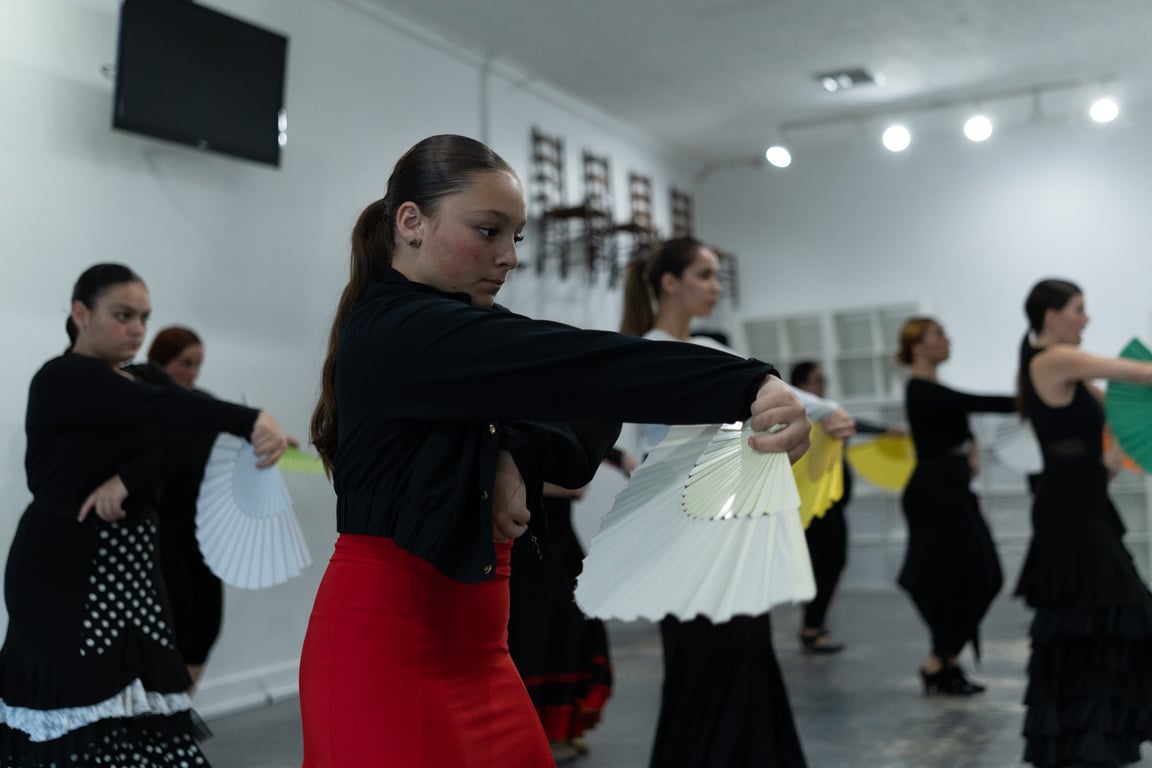
In practice, the fan is used in three broad ways. First, for sudden accents: a fan can be opened or snapped shut on a precise beat, punctuating the compás (rhythmic cycle) with a visual strike that mirrors what the feet or the music are doing. Second, for flutters: a gentle, rapid oscillation of the open fan that adds shimmer and softness, a moment of air and lightness between stronger movements. Third, for gesture: the open fan lengthens the line of the arm, so that a sweep of braceo (the slow, circular arm movement) becomes broader and more sculptural, framing the face or tracing a wide arc across the body.
What makes the fan compelling is the interplay between these modes — the contrast between a slow, luxurious opening and an abrupt, percussive close, between stillness and flutter. Handled well, the abanico turns the hands into a second voice in the dance.
The Fan and the Guajira
If the fan has a home in flamenco, it is the guajira. The guajira is an ida y vuelta ("round-trip") palo — one of the styles that traveled from Spain to the Americas and returned carrying Latin American influence — and its roots are Cuban; the word recalls the guajiros, the country farmers of Cuba. Traditionally staged as elegant, swaying, and feminine in character, the guajira moves with a lilting, graceful compás rather than raw force.
That temperament is exactly why the fan suits it. Where a grave, intense palo asks for free, expressive hands, the guajira invites poise and display, and the abanico becomes a natural partner to its unhurried, sculptural movement. The same graceful staging is why the guajira is also one of the numbers most associated with the large embroidered mantón (shawl): these elegant palos give a dancer room to work with a beautiful object in the hands. If you would like to understand this style in depth, our guide to what guajiras are traces its history and character.
Ready to put this into practice?
Train with Siudy Garrido through our On-Demand Flamenco Courses — structured, professional flamenco instruction you can start today.
Where the Fan Does Not Belong: An Accuracy Note
Here is a point that separates real understanding of flamenco from a tourist's image of it. The fan, like castanets, is not used in the deep cante jondo forms. This is not a stylistic preference but a matter of how the most serious flamenco actually works.
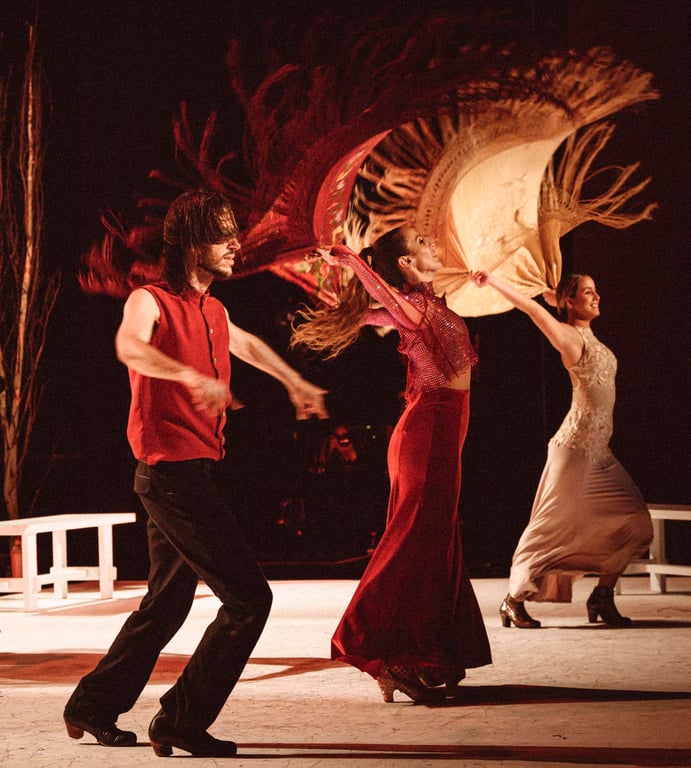
In the profound, cante-driven palos — soleá, seguiriya, and their kin — the dancer's hands stay free. They must, because the entire expressive weight of the dance passes through them: the slow, circular braceo of the arms and the intricate floreo (the rotation of the wrists and articulation of the fingers) are how the body answers the anguish and gravity of the cante (song). To place a fan in the hand would restrict precisely the movement that carries the feeling. This is the same reason castanets have no place in this repertoire, however much they are associated with Spanish dance in the popular imagination; they belong to the escuela bolera and classical Spanish dance, and within flamenco appear only in festive, folkloric, and ida y vuelta styles.
So the fan is not a general symbol of flamenco; it is a specific choice for specific, lighter numbers. A dancer who understands the art reaches for the abanico in a guajira and sets it down entirely for a soleá. To go deeper into the hand and arm work that the serious palos depend on, see our guide to flamenco arms, braceo and floreo.
Learning Fan Work: Practical Notes for Beginners
For a student, the abanico is best understood as a layer added on top of a foundation, never a shortcut around one. A few principles will keep your first steps with the fan productive.
- Build the foundation first. Steps, postura (the proud, grounded posture), and compás come before the fan. The prop rewards a dancer who already moves cleanly; it exposes one who does not.
- Master the open and close on its own. Before combining it with anything, practice opening and snapping the fan shut cleanly and quietly, landing each action exactly on the beat. The crispness of that timing is most of the fan's effect.
- Separate the fan from the feet at first. Coordinating a busy hand with zapateado (footwork) is hard. Drill the fan work slowly with simple marking steps before layering it over full choreography.
- Protect the arm line. The danger with any prop is that the arm goes stiff around it. Keep the braceo long and flowing even while a hand is occupied, so the fan extends the line rather than freezing it.
- Match the fan to the palo. Study fan work within an appropriate style such as the guajira, where it belongs, rather than importing it into forms where it would be out of place.
Approached this way, the abanico becomes what it is meant to be: not a trick, but an extension of the dancer's gesture, obedient to the same compás and the same taste that govern everything else in flamenco.
Where to Go From Here
The flamenco fan is a small object that teaches a large lesson: in this art, every prop, step, and gesture has its proper place, and mastery lies in knowing which tool serves which form. If you would like to build the foundation that fan work sits upon, explore Siudy Garrido's on-demand flamenco classes to study posture, compás, and movement in sequence, and browse more guides on our flamenco blog to keep deepening your understanding of the art.
Frequently asked questions
What is the flamenco fan called?
Which flamenco style uses a fan?
Is the fan used in all flamenco dances?
Is the abanico hard to learn for beginners?
Start dancing flamenco with Siudy Garrido
On-Demand Flamenco Courses — professional instruction, at your pace.
Explore Courses →