Flamenco Accessories: The Complementos of the Dance Explained
 Part of our guide
Flamenco Dress and Attire: A Complete Guide to What Flamenco Dancers Wear →
Part of our guide
Flamenco Dress and Attire: A Complete Guide to What Flamenco Dancers Wear →
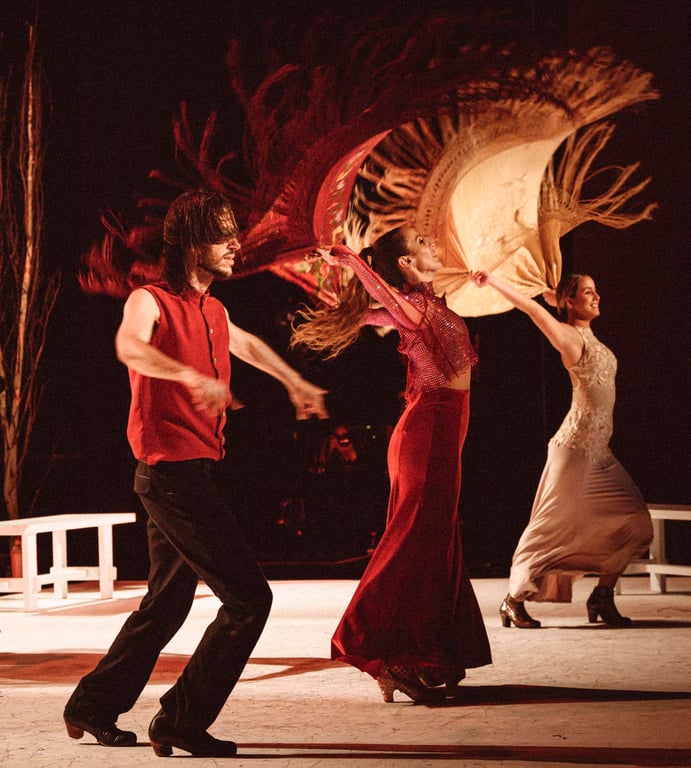
When most people picture a flamenco dancer, they see the whole image at once: the ruffled dress, the flower fixed in the hair, the great fringed shawl swinging through the air. Yet each of those elements is a distinct object with its own name, purpose, and history. In Spanish they are known collectively as the complementos (the complements, or accessories) of the dance. This guide walks through them one by one, and draws an important line between the pieces that are purely decorative and the ones the dancer actually dances with.
This article is part of our broader guide to flamenco dress and attire. There we cover the garments themselves; here we focus on everything that completes and accompanies them.
What Are Flamenco Accessories?
The complementos are the flamenco accessories that finish the traje de flamenca (the flamenco dress) and, in some cases, become part of the choreography itself. It is useful to sort them into two families from the outset, because they are often confused. The first family is decorative: worn pieces that frame the dancer and complete the visual composition. The second is the danced props: objects the dancer manipulates as an extension of the movement.
Getting this distinction right matters. A hair flower is chosen and pinned before the dance begins and then simply worn; a large shawl, by contrast, is handled and thrown and gathered throughout a number, demanding as much skill as the footwork. Understanding which is which is the first step to understanding how a flamenco image is actually assembled.
Decorative Accessories: Framing the Dancer
The decorative complementos are worn rather than danced. They do not change during a performance; they are part of how the dancer is dressed and presented. Four are especially characteristic.
- Peineta — a peineta is a decorative comb, set into the hair to lift and shape it. It gives the head a proud, elevated line that echoes the upright postura of the dance.
- Flor — the flor is the hair flower, often large and boldly colored, pinned to one side of the head. More than any other single accessory, it signals "flamenco" at a glance.
- Pendientes — pendientes are earrings, typically large and eye-catching, chosen to catch the light and read from a distance on stage.
- Mantoncillo — the mantoncillo is a small shoulder shawl, worn over the dress as adornment. Its name is the diminutive of mantón, and the size difference is the whole point: this is a decorative piece, not a danced one.
Together these accessories complete the silhouette. None of them is manipulated as part of the choreography; their job is to frame the dancer and finish the composition the audience sees.
Danced Props: The Manton and the Abanico
The second family of flamenco accessories is different in kind. These are objects the dancer works with actively, so that handling them well becomes part of the artistry itself.
The mantón de Manila (the Manila shawl) is a large, square, embroidered silk shawl with long fringe. It reached Andalusia through the Manila galleon trade, by which Chinese silk was routed through Manila, then part of the Spanish Empire, to Seville, and it has been used since the late eighteenth century. Dancing with the mantón demands strength, timing, and control; a skilled dancer sends it sweeping through broad, sculptural arcs that seem to hang in the air. It is prominent in the guajira and other elegant numbers. This is a discipline in its own right, which we explore in our guide to dancing with the mantón.
Ready to put this into practice?
Train with Siudy Garrido through our On-Demand Flamenco Courses — structured, professional flamenco instruction you can start today.
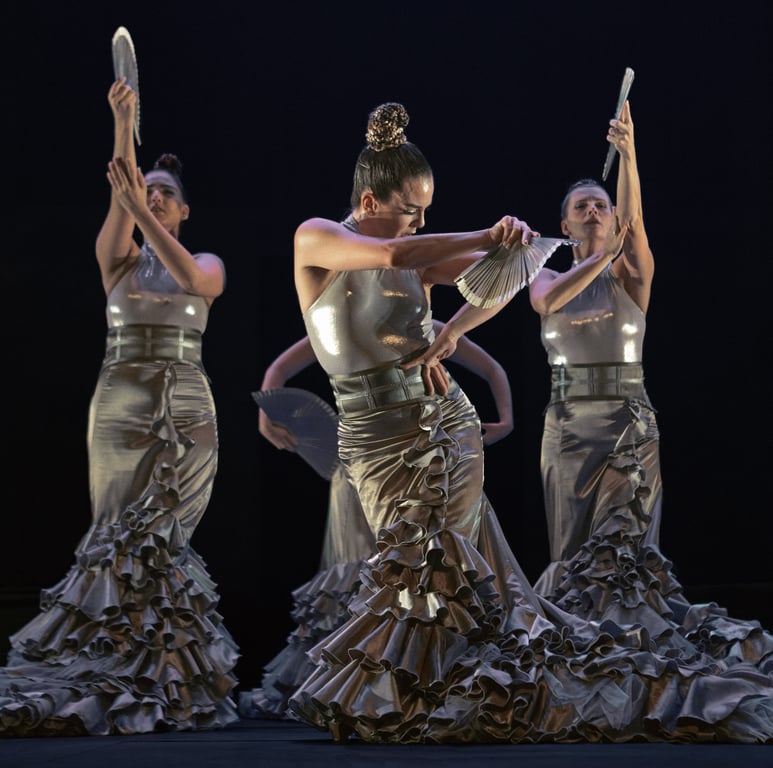
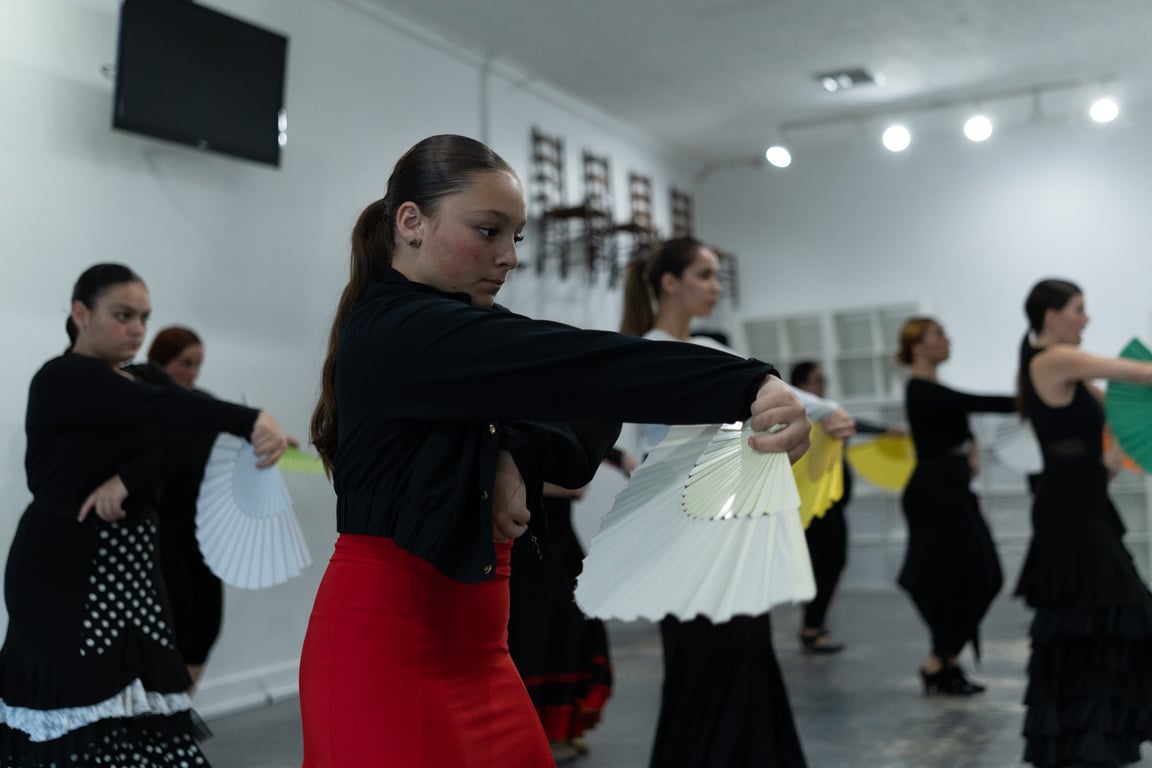
The abanico (the hand fan) is the other principal danced prop. Rather than a fixed decoration, it is used for sudden accents, flutters, and gesture, opening and closing in time with the music. It is strongly associated with the guajira. Learning to command it, so that it becomes an extension of the arm rather than an object simply held, is a study in itself; we cover it in dancing with a fan (abanico).
One point ties these two props together. Like castanets, both the mantón and the abanico belong to particular, often elegant styles; they are not used in the deep cante jondo forms, where the hands stay free for braceo (the arm movement) and floreo (the wrist and finger articulation) that carry so much of flamenco's feeling.
Castanets: A Common Misconception
Castanets, the castañuelas (also called palillos), are what many newcomers assume every flamenco dancer must use. In fact they are not a core flamenco instrument. They are central to classical Spanish dance and the escuela bolera, a distinct tradition, rather than to flamenco proper.
The reason is practical as much as historical. In the deep cante jondo forms, such as soleá, seguiriya, and tientos, the dancer's hands must stay free for braceo and floreo. Holding castanets would restrict exactly the expressive hand and wrist movement that gives those forms their power. Castanets appear instead in festive, folkloric, and lighter styles, among them sevillanas and fandangos de Huelva. In construction they are two hollowed hardwood shells per hand, clicked with the fingers. If you want the fuller story, see our dedicated piece on castanets in flamenco.
Flamenco Shoes: Built for Footwork
The last of the complementos is easy to overlook because it sits on the floor, yet it is arguably the most functional of all. Flamenco shoes are not a decorative accessory; they are an instrument built for zapateado (the percussive footwork that flamenco is famous for).
Their defining feature is the clavos (nails), small nails driven into the toe and heel of the shoe. These sharpen and amplify each strike, so that the distinct sounds of the footwork carry to an audience. The dancer's vocabulary of strikes, the planta (ball of the foot), the tacón (heel), and the golpe (the whole flat foot at once), all depend on a shoe that answers cleanly and loudly. In this sense the shoe is less an accessory than a tool of the trade, engineered so that the rhythm of the feet becomes audible music.
How the Accessories Work Together
Seen as a whole, the complementos are not interchangeable ornaments but a considered system. The decorative pieces, the peineta, the flor, the pendientes, and the mantoncillo, compose the image the audience first perceives. The danced props, the mantón de Manila and the abanico, extend the dancer's movement into the air and belong to particular, often elegant palos. The shoes, with their clavos, turn the floor into a percussion instrument. And castanets, for all their fame, sit slightly apart, at home in classical Spanish and folkloric dance rather than at the core of flamenco.
Understanding these flamenco accessories is really understanding how flamenco composes itself, visually and rhythmically, out of many separate parts. To see how the danced props in particular come alive in motion, explore Siudy Garrido's on-demand flamenco classes, and browse more guides on our flamenco blog to keep going deeper into the art.
Frequently asked questions
What are the accessories worn with flamenco dress?
What is the difference between a manton and a mantoncillo?
Are castanets a flamenco accessory?
What makes flamenco shoes different from ordinary shoes?
Start dancing flamenco with Siudy Garrido
On-Demand Flamenco Courses — professional instruction, at your pace.
Explore Courses →