Flamenco Costume: Authentic Dress vs. the Party Version
 Part of our guide
Flamenco Dress and Attire: A Complete Guide to What Flamenco Dancers Wear →
Part of our guide
Flamenco Dress and Attire: A Complete Guide to What Flamenco Dancers Wear →
Search for a flamenco costume online and you will meet two very different things wearing the same name. One is a genuine garment with centuries of Andalusian history behind it, worn at Spanish fairs and on the world's great stages. The other is a mass-produced party outfit, a few ruffles and oversized polka dots stitched onto a novelty dress. Understanding the gap between them is the first step toward dressing in a way that honors the art rather than caricaturing it.
This guide, part of our broader look at flamenco dress and attire, explains what a real flamenco costume actually is, from the everyday festive dress to the demanding performance garments, and then offers honest guidance for anyone assembling a respectful, flamenco-inspired outfit.
What a Flamenco Costume Really Is
When Spaniards speak of flamenco dress, they are not describing a costume in the theatrical or Halloween sense at all. They mean real clothing with a living cultural role. The word costume in English blurs an important distinction: the authentic garments are worn seriously, by dancers who have trained for years and by ordinary people celebrating at a fair, not as a joke or a one-night disguise.
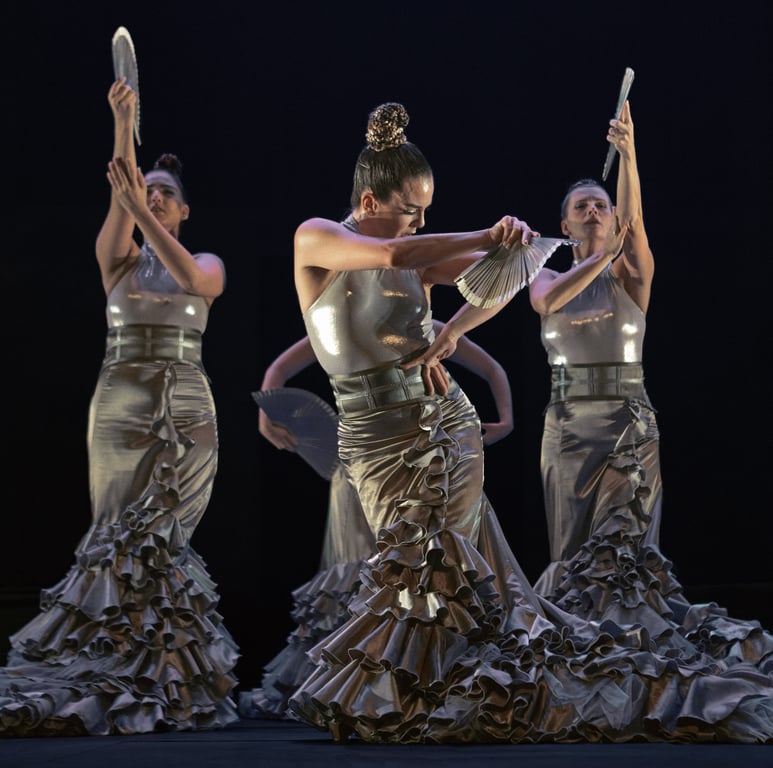
The heart of it is the traje de flamenca, literally the “flamenco dress” — the fitted, flowing garment most people picture. Its defining features are volantes (ruffles) that cascade down the skirt and often the sleeves, and, very often, lunares (polka dots), the bold round spots that read as flamenco at a glance. Unlike a shop costume, a real traje is structured and fitted to the body, built to move with the dancer and to hold its sculptural shape as the skirt sweeps. We cover this garment in depth in our guide to the traje de flamenca dress, and give a plain-language overview of what flamenco dancers wear for those new to the subject.
The Bata de Cola: Dress for Performance
Where the traje de flamenca belongs to fairs and everyday celebration, the bata de cola belongs to the stage. This is the flamenco dress with a long, ruffled train that extends behind the dancer, and it is reserved for advanced performance rather than casual wear.
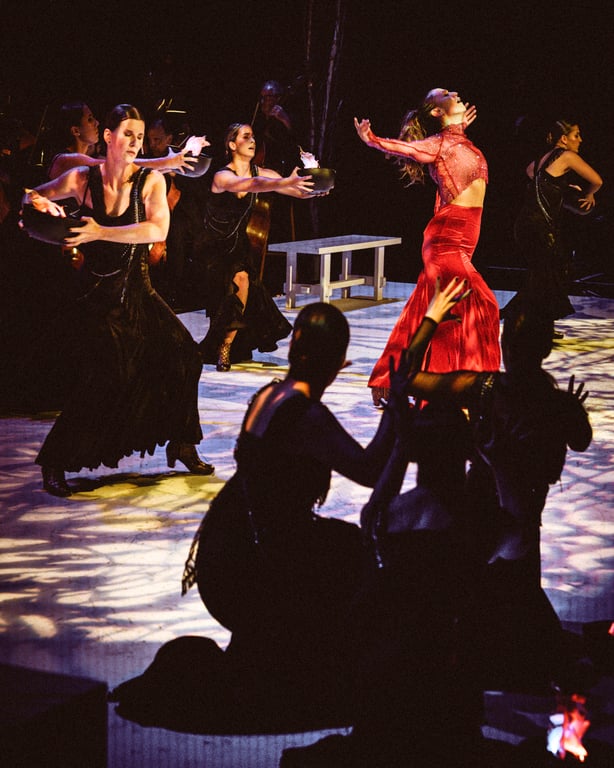
The bata de cola is far more than decoration. Moving in it is a discipline in its own right: the dancer must learn to gather, kick, and sweep the heavy train with precise, timed motions of the legs and feet, so that the fabric becomes an extension of the choreography rather than an obstacle. In skilled hands it produces some of flamenco's most breathtaking imagery — broad arcs of cloth carving through the air in time with the compás (the rhythmic cycle). This is emphatically not a garment one buys as a costume and simply wears; it is a specialist's tool that demands training to control.
The Manton, Mantoncillo, and Other Accessories
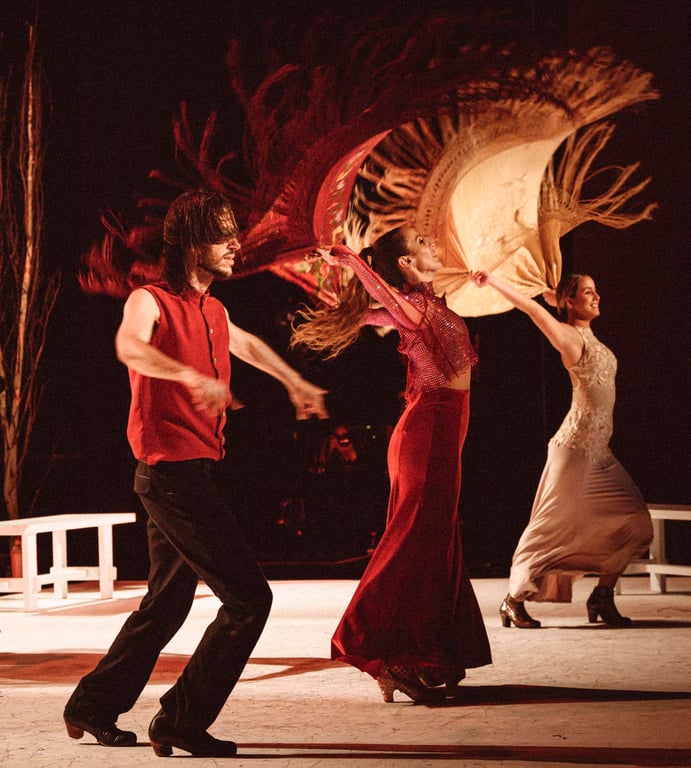
A flamenco outfit is completed by its complementos, or accessories, and these do a great deal of the visual work. Chief among them are the shawls. The mantón de Manila is a large, square, embroidered silk shawl with a long fringe; it reached Andalusia through the Manila galleon trade, which routed Chinese silk through Manila — then part of the Spanish Empire — to Seville, and it has been in use since the late 18th century. Dancing with it demands real strength and timing, and it produces broad, sweeping, sculptural motion on stage. Its smaller relative, the mantoncillo, is a small shoulder shawl worn draped over the traje de flamenca as part of the everyday festive look.
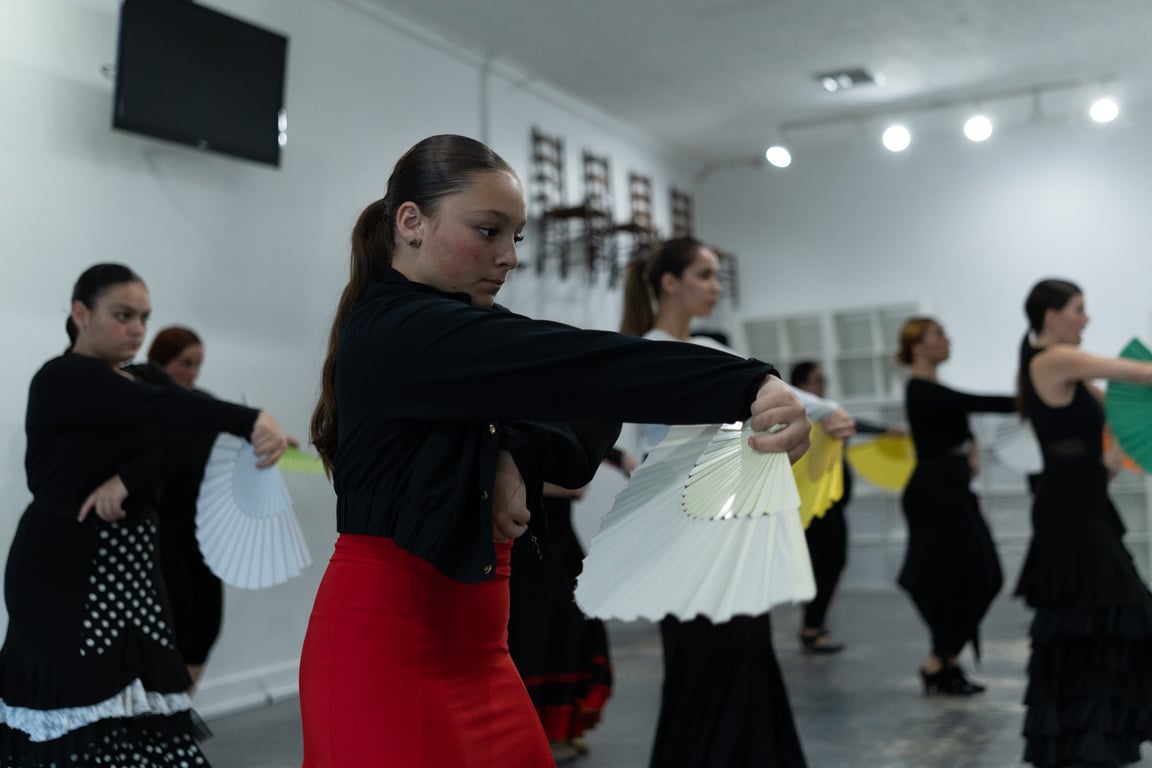
Beyond the shawls, the traditional accessories include the peineta (a decorative comb set in the hair), the flor (a hair flower, often worn to one side), large pendientes (earrings), and the abanico (a hand fan, which appears in certain elegant numbers as a prop for accents and flutter). Our full guide to flamenco accessories explains how each of these is chosen and worn. One accessory deserves a note of caution: castañuelas (castanets) are widely assumed to be essential flamenco, but they are actually folkloric and appear only in festive styles, not in the deep, cante-driven forms where the dancer's hands stay free. They are optional and style-specific, not a default.
Ready to put this into practice?
Train with Siudy Garrido through our On-Demand Flamenco Courses — structured, professional flamenco instruction you can start today.
Men's Flamenco Dress: The Traje Corto
Flamenco costume is not only a woman's affair. Men have their own distinctive attire, centered on the traje corto — literally the “short suit.” It consists of a short, close-fitting jacket, high-waisted trousers, and boots, a silhouette that emphasizes the strong, sober lines associated with male flamenco dance.
The traje corto is understated where the women's dress is exuberant, and that restraint is the point: it frames the forceful, percussive footwork of the male dancer without competing with it. Any respectful account of flamenco dress needs to include it, because the popular image of flamenco as ruffles and polka dots alone erases half the tradition.
Flamenco Shoes: Built for Sound
No flamenco outfit is complete without the shoes, and here function matters as much as form. Flamenco shoes are made specifically to serve zapateado, the percussive footwork at the core of the dance. Their defining feature is the clavos — small nails hammered into the toe and heel of the sole — which sharpen and amplify each strike so that the foot becomes a true percussion instrument.
This is one of the clearest lines between a real flamenco costume and a party version. A novelty outfit pairs the dress with ordinary shoes or none at all; authentic flamenco dress treats the shoes as essential equipment, tuned to produce the crisp, resonant sound that a bare or unsuitable shoe simply cannot make. If you are drawn to the dance itself rather than only the look, the shoes are where costume and craft meet.
Dressing Flamenco-Inspired, Respectfully
Suppose you are not a trained dancer but want to put together a flamenco-inspired look for a themed event, a Spanish celebration, or simply out of admiration for the art. It can absolutely be done with grace. The guiding principle is to reach for the real silhouette rather than a cartoon of it.
What makes an outfit genuinely read as flamenco is the combination of a fitted dress with true volantes (ruffles), a measured use of lunares (polka dots), and the right accessories worn thoughtfully — a flor in the hair, a peineta, large earrings, and a mantoncillo across the shoulders. These are the elements that Spaniards themselves wear to the feria, and leaning on them keeps you in respectful territory.
What to avoid is just as important. Steer clear of the plastic novelty versions sold purely as a gag, of any single element worn as a punchline rather than as part of a coherent look, and of treating the dress as a disguise rather than as clothing. The difference between homage and caricature is mostly a matter of intent and care: dress as though you respect where the garment comes from, because you do. When you are unsure, look at how the traje de flamenca is actually worn in Spain and let that be your reference.
Ultimately, the surest way to understand flamenco dress is to understand flamenco itself — how the dancer moves, why the shoes are built as they are, and how the shawl and skirt become part of the choreography. If that curiosity is stirring in you, explore Siudy Garrido's on-demand flamenco classes to feel how the movement and the dress belong to each other, and browse more guides on our flamenco blog to keep learning about the culture behind the costume.
Frequently asked questions
What is a real flamenco costume called?
What is the difference between a flamenco costume and a real flamenco dress?
What accessories go with a flamenco outfit?
How can I dress in a flamenco-inspired way respectfully?
Start dancing flamenco with Siudy Garrido
On-Demand Flamenco Courses — professional instruction, at your pace.
Explore Courses →