The Benefits of Learning Flamenco: Body, Mind, and Spirit
 Part of our guide
How to Learn Flamenco: A Complete Guide for Beginners →
Part of our guide
How to Learn Flamenco: A Complete Guide for Beginners →
People come to flamenco for the drama of it — the storm of footwork, the sculpted arms, the raw cry of the singer. What surprises most students is how much the art gives back once they begin. Studying flamenco is not only learning to dance; it is a form of training that reaches the body, the mind, and the spirit at the same time. This guide offers a measured look at the real benefits of learning flamenco, across four dimensions that any serious student comes to know.
It belongs to our broader guide on how to learn flamenco, and it is written not to oversell the art but to describe honestly what it develops. Flamenco is demanding, and that difficulty is precisely where much of its reward lives.
The Physical Benefits of Learning Flamenco
Among the most immediate benefits of learning flamenco are the physical ones. Flamenco is genuinely athletic, and even an introductory class will remind you of muscles you had forgotten you owned. It is best thought of as demanding, full-body movement rather than measured in numbers — but its physical demands are real.
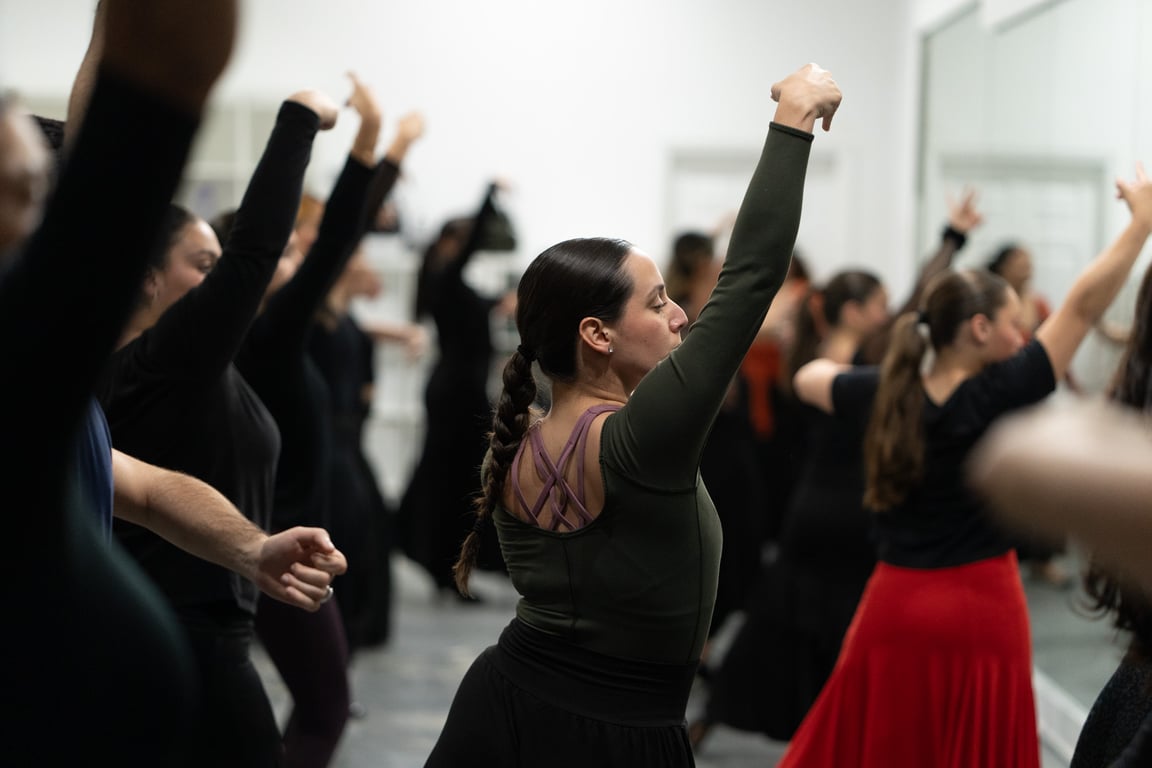
The percussive footwork flamenco is famous for, called zapateado (rhythmic striking of the feet), builds lower-body stamina and endurance through sustained, repetitive effort. Above the waist, everything rests on postura (the proud, grounded carriage of a flamenco dancer): a long spine, an open chest, and weight rooted through the floor. Holding that posture through a full piece is quiet, continuous work for the core, and over time it tends to improve how you carry yourself even away from the studio.
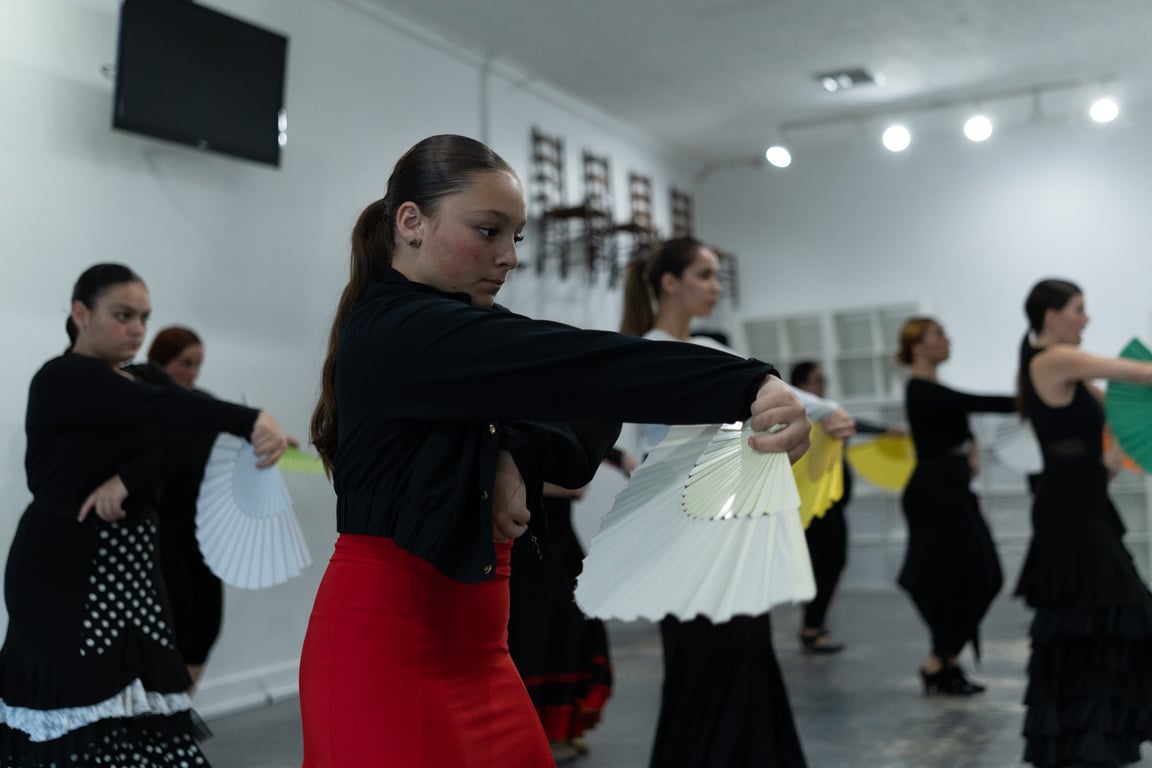
Flamenco also asks for a rare degree of coordination. The feet drive rhythm while the arms move in slow, circular braceo (arm movement) and the wrists and fingers articulate in floreo (wrist rotation and finger work) — often all at once, and all in time. Learning to run these independent movements together develops whole-body coordination and balance in a way few other activities match. We explore this side of the art in more depth in our guide to whether flamenco is good exercise.
The Cognitive Benefits: Rhythm, Memory, and Focus
If the physical rewards are the most visible, the cognitive ones may be the most transferable. At the center of them sits compás (the rhythmic cycle that organizes every flamenco form). Internalizing compás is genuine mental training, and it is often the single greatest challenge a new student faces.
Flamenco rhythm is not simple counting. Many palos, or styles, share a distinctive twelve-beat cycle — among them soleá, alegrías, and bulerías — differing in tempo and character, while others, such as tangos, sit in a simpler four-count feel. Holding one of these cycles steady in your body while coordinating footwork and arms trains timing, working memory, and sustained attention together. You are, in effect, keeping several things in mind at once and executing them precisely in time.
Beyond rhythm, flamenco asks you to remember sequences, to recall the structure of a dance, and to respond in the moment to the cante (song), since the dancer traditionally answers the singer rather than leading. That combination of memorization and live listening exercises focus and memory in a way that many students find carries over into the rest of their lives. Rhythm training, in particular, is one of flamenco's most durable gifts — a skill built patiently, one clean cycle at a time.
Ready to put this into practice?
Train with Siudy Garrido through our On-Demand Flamenco Courses — structured, professional flamenco instruction you can start today.
The Cultural Benefits: Connecting to a Living Heritage
To learn flamenco is to be welcomed into one of the world's great artistic traditions. This cultural connection is among the deeper benefits of learning flamenco, and it is what distinguishes the art from exercise for its own sake.
Flamenco's heartland is Andalusia, in southern Spain, and it grew over centuries as a fusion of Andalusian folklore, Moorish and Arabic melodies, Gitano (Roma) rhythms, and Jewish and Sephardic influence. In recognition of its value to humanity, UNESCO inscribed flamenco on the Representative List of the Intangible Cultural Heritage of Humanity in 2010. When you learn a palo, you are not simply learning steps; you are taking up a form with real history and meaning behind it.
That awareness changes the experience. Understanding why soleá is solemn, why alegrías come from Cádiz and carry joy, or how the whole art is held together by palmas (rhythmic hand-clapping) and jaleo (encouraging shouts such as ¡olé!) gives depth to every hour of practice. Learning flamenco becomes a way of connecting with a culture, not just a workout — a genuine dialogue with an art that generations have shaped and safeguarded.
The Emotional and Expressive Benefits
Perhaps the most personal of the benefits of learning flamenco are emotional. Flamenco is, at its core, a language of feeling, and studying it gives you a way to express and channel emotion that few other disciplines offer.
Much of this comes down to presence and confidence. The grounded postura, the deliberate carriage, the way a dancer commands the space — these are built in the studio and tend to stay with you. Many students find that the poise flamenco demands on the floor gradually becomes a poise they carry into daily life. Standing tall, holding your ground, and moving with intention are habits the art trains directly.
And then there is duende. Ask any flamenco artist what separates a great performance from a merely correct one, and you will hear this word. Duende is the heightened emotional authenticity, the soul, that lifts flamenco beyond technique into something genuinely moving; the poet Federico García Lorca famously explored the idea in his 1933 lecture on the subject. It is a felt quality, not a step you can drill, and it cannot be manufactured — only summoned when an artist gives everything to the moment. For a student, the pursuit of that release is deeply rewarding: flamenco offers a rare, sanctioned space to feel fully and to let that feeling out through movement. We explore this further in our piece on what duende means in flamenco.
How the Benefits Grow Together
What makes flamenco so rewarding to study is that these four dimensions do not stay separate. The physical stamina you build supports the long sequences that train your memory; the rhythmic discipline of compás sharpens the focus that lets you inhabit a palo emotionally; the cultural understanding gives meaning to the movement, and the expressive release makes the physical effort feel worthwhile. Progress in one area quietly lifts the others.
This is also why the order of study matters. A serious program teaches rhythm and compás first, then posture and arms, then footwork, so that each layer of benefit rests on a solid foundation. Consistency matters far more than intensity: a modest, regular practice compounds, while occasional bursts do not. And flamenco is very commonly begun in adulthood — there is no age ceiling, and the rewards described here accumulate at whatever pace suits you.
Where to Begin
The surest way to understand the benefits of learning flamenco is to feel them for yourself, one compás at a time. Structured video instruction now makes it possible to study the art properly from anywhere, at your own pace, slowing demonstrations down and building the daily habit that real progress requires. Explore on-demand flamenco classes with two-time Latin Grammy–nominated artist Siudy Garrido to begin building rhythm, posture, and expression together, and browse more guides on our flamenco blog to keep going deeper into the art. However you come to flamenco, it tends to give back more than you expect.
Frequently asked questions
What are the main benefits of learning flamenco?
Is learning flamenco good exercise?
Can adults learn flamenco, and will they still see these benefits?
How does flamenco benefit the mind?
Start dancing flamenco with Siudy Garrido
On-Demand Flamenco Courses — professional instruction, at your pace.
Explore Courses →