Flamenco Glossary: Essential Flamenco Terms Explained
 Part of our guide
What Is Flamenco? Meaning, Origins, and the Art Explained →
Part of our guide
What Is Flamenco? Meaning, Origins, and the Art Explained →
Flamenco has a vocabulary all its own, much of it in Spanish, and newcomers often find that a handful of unfamiliar words stand between them and a real understanding of the art. This glossary gathers the essential flamenco terms in one place, grouped by theme and defined concisely, so that you can read about flamenco, watch a performance, or begin to study it with the key words already in hand. It works well alongside our broader guide to what flamenco is, which sets the wider context for everything below.
Use this flamenco glossary as a reference to return to. Each term appears with its Spanish spelling and a short, accurate definition; where a concept deserves fuller treatment, we point to a dedicated guide.
The Essential Flamenco Terms: The Three Elements
Every serious discussion of flamenco begins with its structure. These flamenco terms name the building blocks of the art and the people who bring them to life.
- Cante — the song. Cante is traditionally considered the heart of flamenco and carries much of its emotion; the dancer responds to the singer.
- Toque — the guitar and musicianship that accompanies the song and dance and also stands alone in solo passages.
- Baile — the dance, with its sculpted arms, proud posture, and percussive footwork.
- Cantaor / cantaora — the flamenco singer (male / female).
- Tocaor / tocaora — the flamenco guitarist (male / female).
- Bailaor / bailaora — the flamenco dancer (male / female).
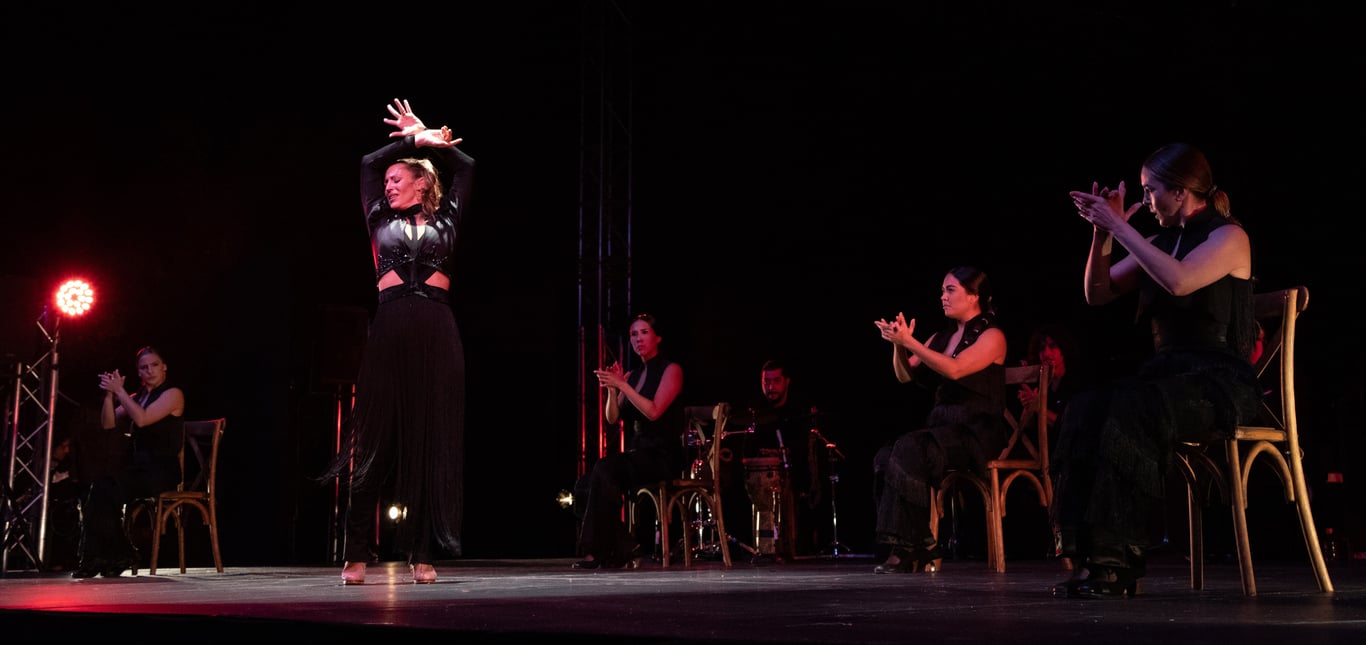
- Palmas — the rhythmic hand-clapping that keeps the pulse; palmas sordas are muffled and deep, palmas claras sharp and crisp.
- Jaleo — the encouraging shouts, such as ¡olé!, ¡vamos!, and ¡agua!, that rise from performers and audience alike.
For a fuller treatment of how these first three fit together, see our guide to the elements of flamenco.
Rhythm and Song
Flamenco is governed by rhythm before anything else, and its song has its own descriptive vocabulary. These terms are among the most important in the glossary.
Ready to put this into practice?
Train with Siudy Garrido through our On-Demand Flamenco Courses — structured, professional flamenco instruction you can start today.
- Compás — the rhythmic cycle that organizes a flamenco piece. Each palo has its own compás, tempo, and character. Our guide to understanding flamenco compás explores it in depth.
- Palo — a flamenco style or form, each with its own compás, tempo, and emotional character.
- Cante jondo — literally “deep song”; the grave, profound side of flamenco singing, associated with forms such as soleá and seguiriya.
- Cante chico — the lighter, more festive side of flamenco singing, associated with brighter, playful forms.
- Falseta — a short melodic phrase the guitarist plays in the spaces between the singer's lines.
- Cajón — a Peruvian box drum introduced to flamenco by Paco de Lucía in the late 1970s and now a standard part of the ensemble.
Dance Technique
The dancer's craft has a precise vocabulary of its own. These flamenco terms name the movements and structural moments that make up a dance.
- Zapateado — the percussive footwork flamenco is famous for. Its core strikes are the planta (ball of the foot), tacón (heel), golpe (the whole flat foot at once), and punta (toe tip). The goal is clarity and compás, never speed for its own sake.
- Braceo — the arm movement: slow, circular, and continuous.
- Floreo — the rotations of the wrists and the articulation of the fingers.
- Marcaje — marking steps; the connective movement a dancer makes while the cante unfolds.
- Llamada — a “call” that signals a change or an entry.
- Escobilla — the footwork-showcase section of a dance.
- Remate — a short, emphatic closing accent.
- Desplante — an emphatic closing flourish or break.
- Vuelta — a turn. Common types include the vuelta normal (basic turn), the vuelta quebrada (a “broken” turn taken with a torso twist), and the vuelta de pecho (a “chest turn”).
Guitar
The toque carries its own set of terms, most of them naming right-hand techniques or parts of the instrument.
- Rasgueado — rhythmic strumming with the fingers flicked outward in a fan-like motion; the single most defining flamenco-guitar technique.
- Picado — fast single-note scale runs, typically played with alternating fingers.
- Alzapúa — a thumb technique that drives bass lines and riffs, often across several strings.
- Tremolo — the rapid repetition of a treble note, creating the impression of a sustained melody.
- Golpe — a percussive finger tap on the guitar that accents the compás.
- Golpeador — the transparent tap plate glued to the soundboard to protect it from golpes.
Styles: The Palos of Flamenco
The palos are the named forms of flamenco, each a distinct emotional world. These are among the most useful terms to recognize when listening. Our overview of the palos of flamenco maps the main families in full.
- Soleá — slow, solemn, and majestic; its name is linked to soledad (solitude), and it is often called a “mother” form. It shares a twelve-beat cycle with several other palos.
- Bulerías — the fastest, most syncopated, and festive of the twelve-beat family.
- Alegrías — bright and joyful; from Cádiz; also part of the twelve-beat family.
- Tangos — a straightforward four-count palo, a common entry point for beginners; not to be confused with the Argentine tango.
- Seguiriya — grave and tragic in character, with a distinct accent pattern.
- Fandango — a broad family of festive and expressive forms, including regional variants such as the fandangos de Huelva.
Culture and Setting
A final group of flamenco terms names the settings, the ensemble, and the dress in which the art lives, along with the elusive quality every artist chases.
- Duende — the heightened emotional authenticity, or soul, that lifts a performance beyond technique; famously explored by Federico García Lorca in his 1933 lecture. It is a felt quality, not a technique.
- Tablao — both the wooden platform a dancer dances on and, by extension, the venue where flamenco is performed. Tablaos spread across Spain in the 1960s.
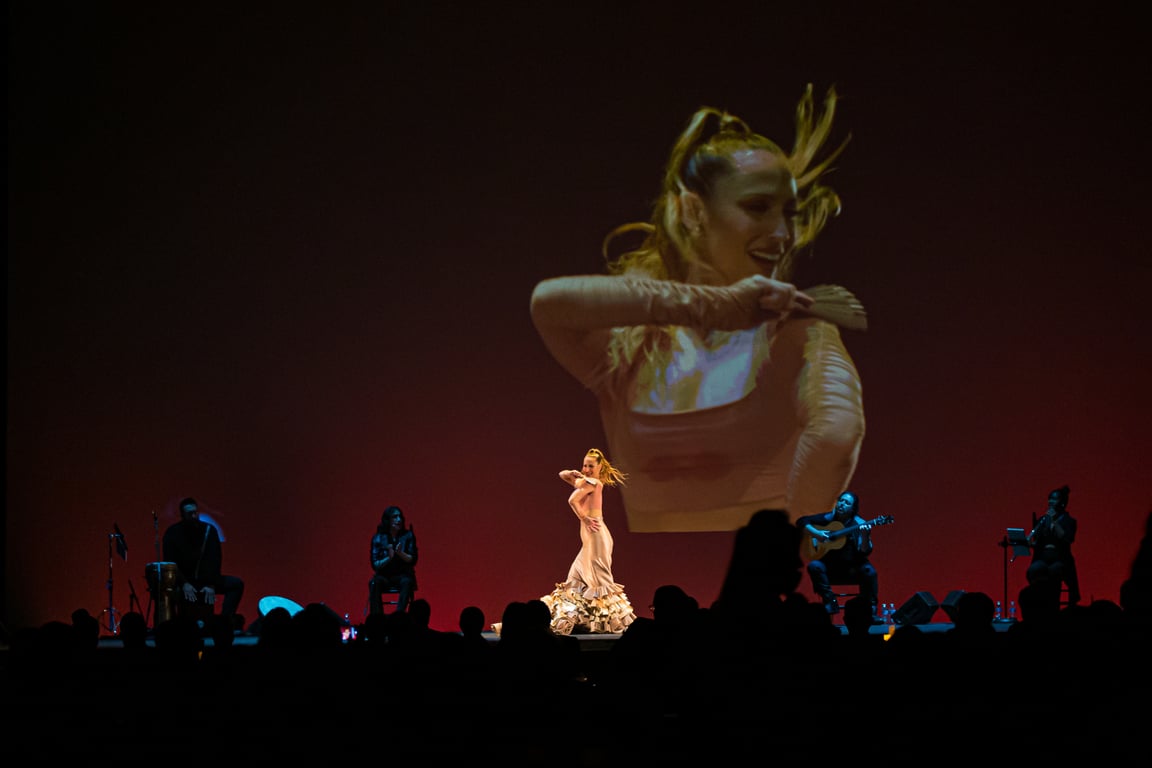
- Cuadro flamenco — the performing ensemble, at minimum a singer, a guitarist, a dancer, and palmas; larger cuadros add more of each.
- Ida y vuelta — literally “round trip”; palos that traveled to the Americas and returned to Spain carrying Latin American influence, such as guajiras, rumba, and colombianas.
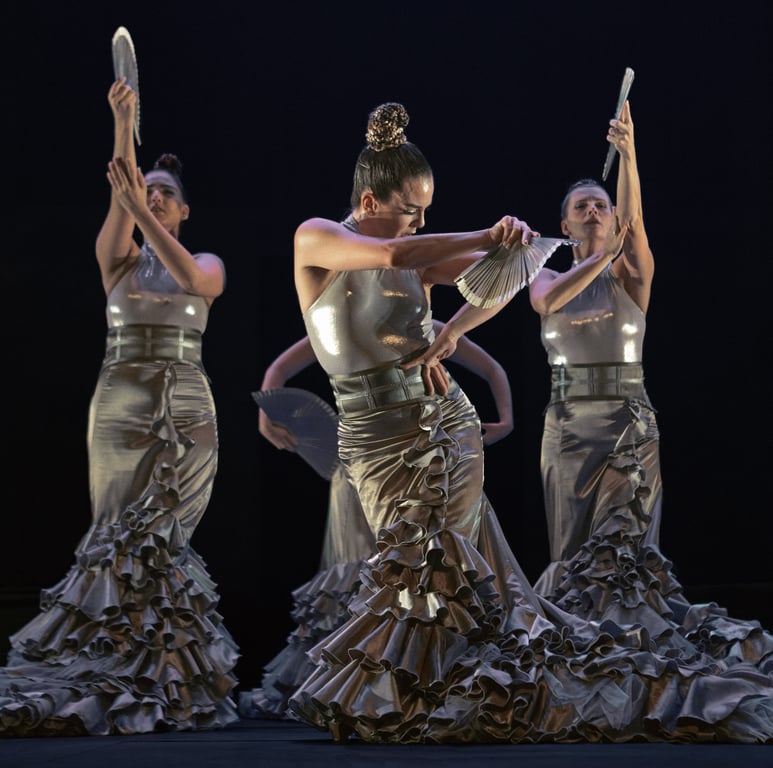
- Traje de flamenca — the festive flamenco dress, typically with volantes (ruffles) and lunares (polka dots).
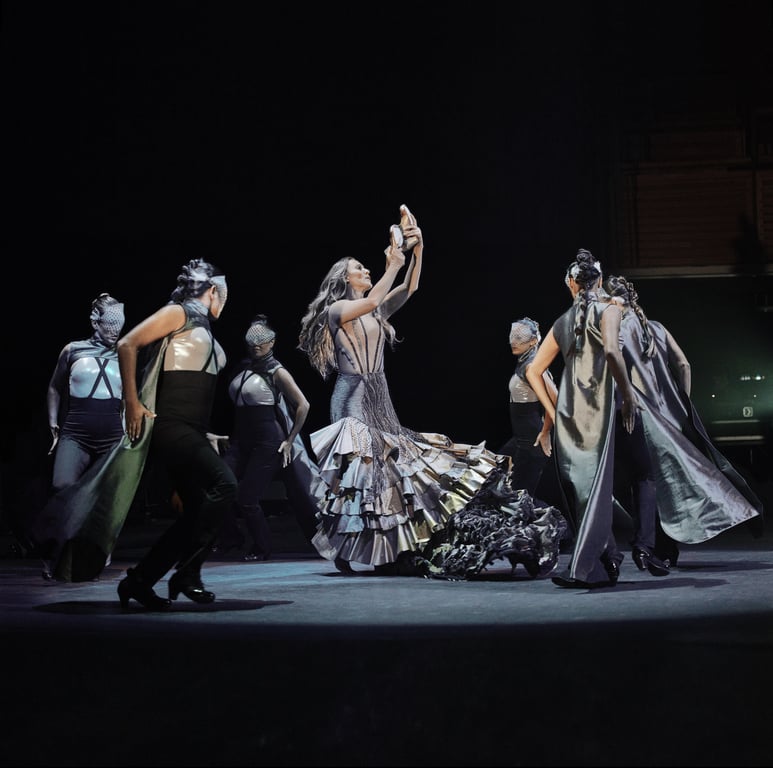
- Bata de cola — the long-train dress used in advanced performance, which demands considerable strength and control to dance.
This glossary is a starting point rather than a complete dictionary; flamenco's vocabulary is deep, and each term above opens onto more. As you keep reading and watching, these words will move from unfamiliar to second nature. When you are ready to feel how compás, cante, and baile fit together in practice, explore on-demand flamenco classes with two-time Latin Grammy–nominated artist Siudy Garrido, or browse more guides on our flamenco blog to keep building your understanding of the art.
Frequently asked questions
What are the three core elements of flamenco?
What does compas mean in flamenco?
What is a palo in flamenco?
What is duende in flamenco?
Start dancing flamenco with Siudy Garrido
On-Demand Flamenco Courses — professional instruction, at your pace.
Explore Courses →