Famous Flamenco Singers: The Great Cantaores and Cantaoras
 Part of our guide
Famous Flamenco Artists: The Great Singers, Guitarists, and Dancers →
Part of our guide
Famous Flamenco Artists: The Great Singers, Guitarists, and Dancers →
When people picture flamenco, they often see the dancer first: the sculpted arms, the storm of footwork, the proud carriage. Yet ask the artists themselves where the art truly begins, and most will point not to the feet but to the voice. This guide profiles the most famous flamenco singers and explains why the sung element, the cante, is so often called the soul of flamenco. It is part of our wider look at the famous flamenco artists who shaped the tradition.
Why Cante Is the Root of Famous Flamenco Singers
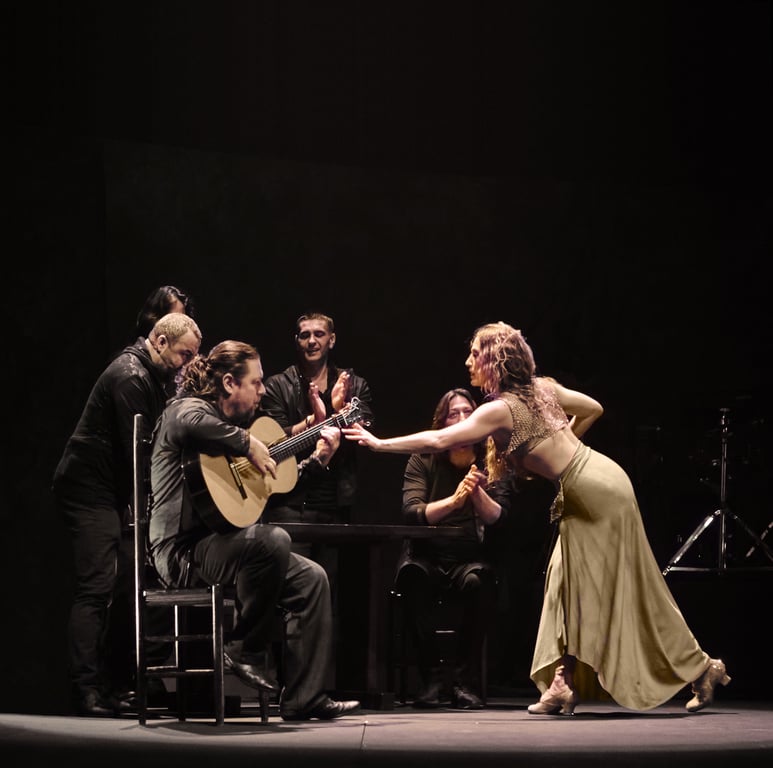
Flamenco fuses three intertwined elements: cante (song), toque (guitar and musicianship), and baile (dance). Of the three, the cante carries much of the art's emotion, and in the traditional order of things the dancer responds to the singer rather than leading. The voice sets an emotional current; the guitarist shapes the harmony and rhythm around it; the dancer answers it. Understood this way, the singer sits at the expressive center of a flamenco performance.
A male flamenco singer is a cantaor and a female singer a cantaora. The finest of them are prized less for beauty of tone in the conventional sense than for the raw, weathered honesty they bring to a phrase. If you want to understand the mechanics of the sung element in more depth, our guide to what cante is examines the song itself; here we turn to the voices that gave it its history.
Camaron de la Isla: The Voice That Changed Everything
No discussion of famous flamenco singers can begin anywhere but with Camaron de la Isla. Born Jose Monje Cruz in San Fernando, Cadiz, on 5 December 1950 into a Spanish Gitano (Roma) family, he is widely regarded as the greatest modern cantaor. His partnership with the guitarist Paco de Lucia, and later with Tomatito, revived flamenco and pushed it toward new audiences without draining it of its depth. In 1979 he released La leyenda del tiempo, an album built on Lorca-inspired lyrics and non-traditional instruments that helped launch what came to be called nuevo flamenco, or new flamenco. When he died of lung cancer on 2 July 1992, an estimated hundred thousand people attended his funeral, a public grief that few artists in any genre have ever inspired. His life bridges tradition and revolution, which is precisely why we treat it at length in a dedicated profile of Camaron de la Isla.
La Nina de los Peines: A Pillar of the Tradition
Long before Camaron, one voice had already set the standard against which cante would be measured. La Nina de los Peines, born Pastora Pavon Cruz in Seville in 1890, is counted among the greatest cantaoras in the history of the art. Her command of the tradition was such that she was admired by figures well beyond flamenco's own circles, including the poet Federico Garcia Lorca and the composer Manuel de Falla. Lorca, in fact, linked his celebrated idea of duende (the heightened emotional soul of a performance) to the experience of hearing her sing. Her example established that a woman's voice could stand at the very summit of a form often assumed to be dominated by men, and her influence still runs through the cantaoras who followed.
Ready to put this into practice?
Train with Siudy Garrido through our On-Demand Flamenco Courses — structured, professional flamenco instruction you can start today.
Antonio Mairena: Guardian of the Old Songs
If some singers push flamenco forward, others devote themselves to holding it steady, and no one embodied that role more fully than Antonio Mairena. Born Antonio Cruz Garcia in Mairena del Alcor, Seville, in 1909, he became flamenco's great guardian of tradition, working to document and preserve palos (the distinct styles of flamenco) that were in danger of being lost. In 1962 he was awarded the Llave de Oro del Cante, the Golden Key of Song, one of the highest honors a cantaor can receive. Mairena's importance lies in this act of conservation: at a moment when flamenco was beginning to change rapidly, he insisted that the older, purer forms of cante be recorded, studied, and passed on intact rather than allowed to fade.
Enrique Morente: The Cantaor Who Broke the Rules
Where Mairena guarded, Enrique Morente experimented. Born in Granada in 1942, he became one of the most revolutionary cantaores of his era, willing to fuse flamenco with genres far outside its usual borders. His most famous gesture in this direction was the album Omega, which set flamenco alongside the rock band Lagartija Nick and drew on the poetry of Federico Garcia Lorca. Morente's career illustrates a tension that runs through this whole list: the pull between honoring an inherited tradition and stretching it into unfamiliar shapes. He did not reject the old cante so much as trust it enough to place it in new company, proving that flamenco could absorb outside influence and remain unmistakably itself.
Estrella Morente: Carrying the Voice Forward
The story of famous flamenco singers is not confined to the past, and no figure makes that clearer than Estrella Morente, the daughter of Enrique Morente. A leading contemporary cantaora, she has become one of the most recognized flamenco voices of her generation, a recipient of Spain's National Music Award and a Latin Grammy nominee. Growing up inside a household where flamenco was both a heritage and a laboratory, she inherited her father's respect for the tradition alongside his openness to new settings for it. Her prominence today shows that cante remains a living art, handed from one generation to the next rather than sealed in recordings, and that the lineage of great voices continues to renew itself.
Tradition and Innovation: Two Currents, One Art
Read across these five careers and a pattern emerges. La Nina de los Peines and Antonio Mairena represent the tradition at its most rooted, the preservation and mastery of forms handed down over generations. Camaron de la Isla and Enrique Morente pushed outward, carrying cante into fusion and experiment. Estrella Morente inherits both currents at once. Flamenco has always advanced through this exchange: the innovators need something solid to push against, and the traditionalists need renewal to keep the art alive rather than embalmed. The cante that these singers shaped is the emotional root from which the whole art grows, and understanding their voices is one of the surest ways to understand flamenco itself.
If listening to these singers has drawn you toward the art, the natural next step is to feel how cante, toque, and baile fit together in practice. Explore Siudy Garrido's on-demand flamenco classes to study the movement that answers the voice, and browse more profiles and guides on our flamenco blog to keep going deeper into the tradition.
Frequently asked questions
Who is the most famous flamenco singer?
What is a cantaor or cantaora?
Why is cante considered the heart of flamenco?
Are there famous female flamenco singers?
Start dancing flamenco with Siudy Garrido
On-Demand Flamenco Courses — professional instruction, at your pace.
Explore Courses →