Famous Flamenco Guitarists: The Masters of Toque
 Part of our guide
Famous Flamenco Artists: The Great Singers, Guitarists, and Dancers →
Part of our guide
Famous Flamenco Artists: The Great Singers, Guitarists, and Dancers →
Flamenco rests on three intertwined elements: cante (song), baile (dance), and toque (the guitar and musicianship). Of the three, the toque has traveled the furthest in a little over a century, moving from a humble supporting role behind the singer to a concert art capable of filling a hall on its own. This transformation is the work of a handful of extraordinary players. The famous flamenco guitarists profiled here trace a clear arc, from the pioneers who first made the guitar a solo voice to the modern virtuosi who reimagined its harmony, speed, and reach.
This guide is part of our wider look at the famous flamenco artists who shaped the tradition. If you want to understand the instrument itself before meeting its masters, our primer on the flamenco guitar explains how it is built and played.
Paco de Lucia: Foremost of the Famous Flamenco Guitarists
No account of the famous flamenco guitarists can begin anywhere but with Paco de Lucia. Born Francisco Gustavo Sanchez Gomez in Algeciras, in the province of Cadiz, on 21 December 1947, he is almost universally regarded as the most influential flamenco guitarist who ever lived. He did not merely master the tradition he inherited; he expanded it, and in doing so he changed what every guitarist after him believed the instrument could do.
Two bodies of work sit at the center of his legacy. The first is his partnership with the singer Camaron de la Isla, with whom he recorded roughly ten landmark albums through the 1970s, a collaboration widely credited with reviving flamenco for a new generation. The second is his pioneering of flamenco-jazz fusion, working with musicians such as John McLaughlin, Al Di Meola, Larry Coryell, and Chick Corea, and opening the art to harmonies and audiences it had never reached before. In 1981 he formed the Paco de Lucia Sextet, and in 1977 he introduced the Peruvian cajon (a box drum) to flamenco, an instrument now so standard it is hard to imagine the ensemble without it. He came from a musical family: his brothers were the singer Pepe de Lucia and the guitarist Ramon de Algeciras. Paco de Lucia died on 25 February 2014, at the age of 66. His influence is so central that we devote a full profile to him in our study of Paco de Lucia.
Ramon Montoya and Sabicas: The Solo Guitar Pioneers
To appreciate what Paco de Lucia inherited, we have to look back to the players who first freed the guitar from its supporting role. For most of flamenco's history the toque served the cante: the guitarist held the harmony and compas (the rhythmic cycle) while the singer carried the emotion. The idea of the guitar as a solo concert instrument, worthy of a stage on its own, was not obvious, and it had to be argued for one falseta (melodic interlude) at a time.
Ramon Montoya, an early-twentieth-century pioneer, did more than almost anyone to establish the flamenco guitar as a solo concert instrument, giving the toque a formal vocabulary and a seriousness of purpose it had lacked. Building on that foundation, Sabicas, born Agustin Castellon Campos in Pamplona in 1912, elevated the solo flamenco guitar further still and greatly expanded its technique; he was related to Montoya, a family thread linking the two pioneers. Sabicas lived until 1990, long enough to see the solo tradition he had championed become the norm rather than the exception. Between them, these two men turned an accompaniment instrument into a voice that could stand alone.
Ready to put this into practice?
Train with Siudy Garrido through our On-Demand Flamenco Courses — structured, professional flamenco instruction you can start today.
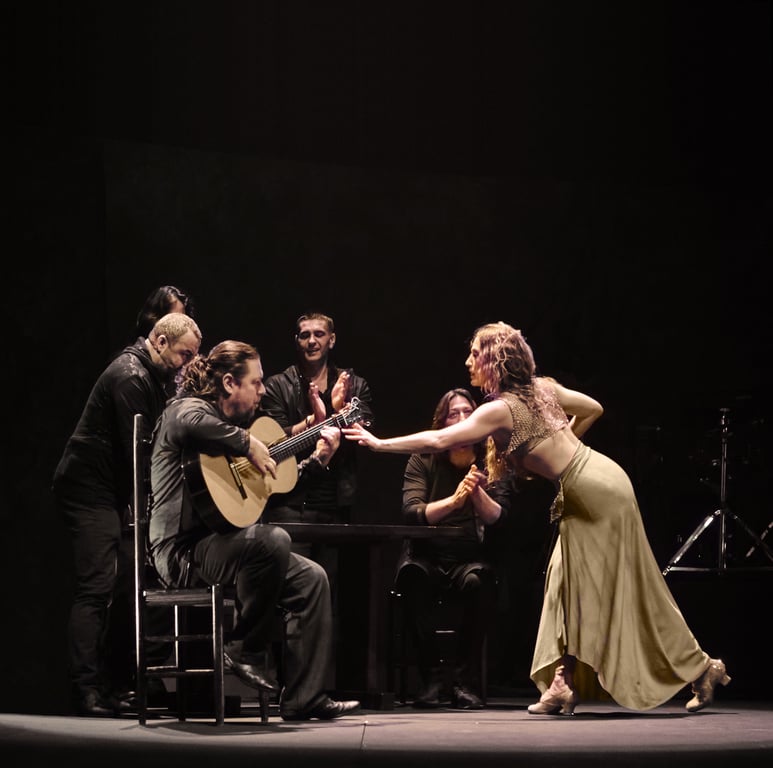
It is worth pausing on how large that shift really was. In the world of the cafes cantantes and the early tablaos, the guitarist sat slightly apart, watching the singer's mouth and the dancer's feet, ready to catch a change of palo or a sudden remate (a short, emphatic closing accent). To step forward and play a piece with no voice at all was to ask an audience to listen to the guitar as they would listen to a cantaor (singer). That the request now seems ordinary is precisely the measure of what Montoya and Sabicas accomplished.
Manolo Sanlucar: Toward the Concert Hall
If Montoya and Sabicas made the guitar a soloist, Manolo Sanlucar, born in 1943, pushed it toward the concert hall. A guitarist and composer, he is known for expanding flamenco toward classical and orchestral forms, treating the toque as a vehicle for large-scale composition rather than only for the traditional palos (flamenco styles). His work broadened the harmonic and structural ambition of flamenco guitar and helped prepare the ground for the generation that followed. His importance as a teacher, too, would prove decisive, as one of his students went on to become among the most admired guitarists of the modern era.
Tomatito and Vicente Amigo: The Modern Virtuosi
The contemporary toque is carried by masters who absorbed everything the pioneers and Paco de Lucia achieved and then pressed further. Tomatito, born Jose Fernandez Torres in 1958, first rose to prominence as the accompanist to Camaron de la Isla, occupying the very role Paco de Lucia had filled and learning it at the highest level. He went on to become a leading modern soloist in his own right, a guitarist whose playing joins deep traditional roots to a fluent, contemporary sensibility. That trajectory, from trusted accompanist to celebrated soloist, echoes the very path the instrument itself has taken across the last hundred years.
Vicente Amigo, born in 1967, represents the lyrical wing of the modern generation. A virtuosic guitarist and composer who studied under Manolo Sanlucar, he is admired for a singing, melodic voice on the instrument, marrying technical command to genuine songfulness. In his playing the long arc of the toque comes full circle: the harmonic sophistication that Sanlucar championed, the expansiveness Paco de Lucia opened up, and the solo authority that Montoya and Sabicas first won, all gathered into a single, contemporary voice.
The Arc of the Toque: From Accompaniment to Art
Read together, these famous flamenco guitarists tell one continuous story. The guitar began as a servant of the song, valued for holding compas and harmony while the singer took the light. Ramon Montoya and Sabicas argued it onto the concert stage; Manolo Sanlucar gave it the ambition of composition; Paco de Lucia burst its boundaries entirely, carrying it into jazz and into rooms flamenco had never entered; and Tomatito and Vicente Amigo now carry that inheritance forward. What unites every one of them is the same discipline that governs all flamenco: the compas comes first, and even the most dazzling falseta means nothing if it does not live inside the cycle.
Understanding the masters of the guitar is one way into flamenco; feeling the rhythm they all serve is another. To sense how the toque binds to cante and baile, explore Siudy Garrido's on-demand flamenco classes, and browse more profiles and guides on our flamenco blog.
Frequently asked questions
Who is the most famous flamenco guitarist?
Who was the first great solo flamenco guitarist?
Which flamenco guitarists are still performing today?
What is the toque in flamenco?
Start dancing flamenco with Siudy Garrido
On-Demand Flamenco Courses — professional instruction, at your pace.
Explore Courses →