Antonio Gades: The Dancer Who Made Flamenco Theatre
 Part of our guide
Famous Flamenco Artists: The Great Singers, Guitarists, and Dancers →
Part of our guide
Famous Flamenco Artists: The Great Singers, Guitarists, and Dancers →
Few figures did more to carry Spanish dance from the intimate stage into the language of full theatre than Antonio Gades. Where earlier generations had refined flamenco as an art of the moment, improvised and personal, Gades helped shape it into something staged, structured, and dramatic — a form that could hold an audience across the length of a full production and, later, across the frame of a cinema screen. This article traces his life, his company, the celebrated films that spread his work worldwide, and the choreographic legacy he left behind.
Who Was Antonio Gades?
Antonio Gades was born Antonio Esteve Ródenas on 14 November 1936 in Elda, a town in the province of Alicante in eastern Spain. He would become one of the defining Spanish dancers and choreographers of the twentieth century, remembered above all for helping to raise Spanish dance into a fully staged theatrical art.
That phrase deserves attention, because it describes exactly what set his work apart. Flamenco and Spanish dance had long lived in the tablao (the flamenco performance venue) and on the concert stage as displays of technique and feeling. Gades belonged to a lineage of artists who asked more of the form: he treated dance as a means of telling a story from beginning to end, with narrative, character, and dramatic shape, rather than as a sequence of numbers. In doing so he helped move Spanish dance closer to the world of theatre and, eventually, of film.
Founding His Own Company
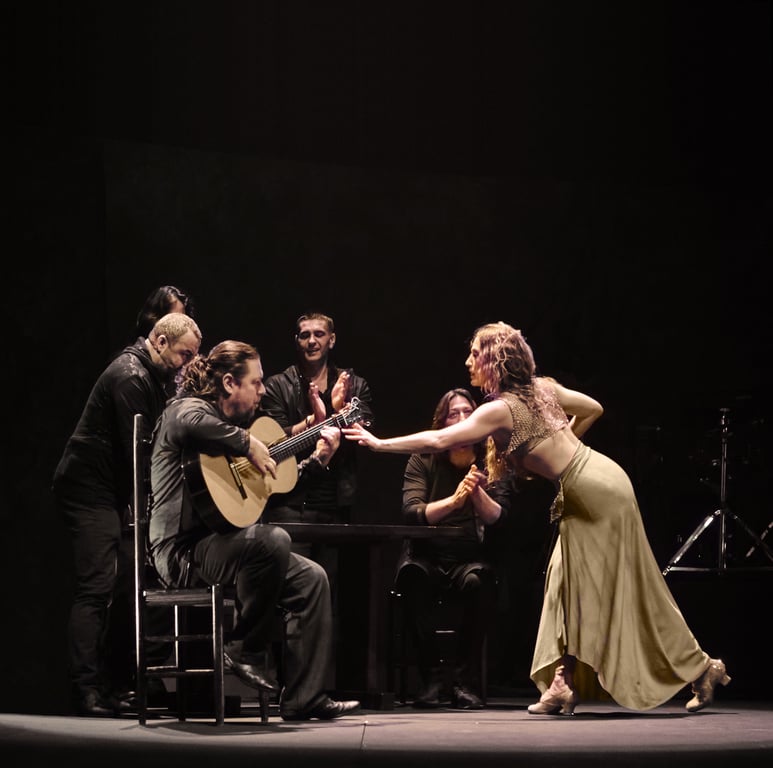
In 1962, Gades founded his own dance company. The decision marked a turning point, both for him and for the wider ambitions of Spanish dance. A company of his own gave him the means to develop full-length works, to rehearse an ensemble toward a unified vision, and to build the kind of sustained, structured productions that a soloist alone could never mount.
It is worth pausing on why founding a company mattered so much for the theatrical direction of his art. Staged, narrative dance requires more than a single brilliant performer; it needs a corps of dancers who can move as one, hold character, and serve a story rather than simply showcase individual virtuosity. By assembling and directing his own ensemble, Gades gave himself the instrument he needed to pursue dance as theatre. The company became the vehicle through which his choreographic ideas took their fullest form.
The Carlos Saura Film Trilogy
If the company gave Gades the means to build theatrical dance, it was his collaboration with the film director Carlos Saura that carried that work to the world. Together they created a trilogy of dance films that stands among the most widely seen presentations of flamenco and Spanish dance ever made.
Ready to put this into practice?
Train with Siudy Garrido through our On-Demand Flamenco Courses — structured, professional flamenco instruction you can start today.
The three films were Bodas de sangre (Blood Wedding), Carmen, and El amor brujo (a title often rendered as Love, the Magician). Each translated Gades's stage choreography into the intimate, unforgiving medium of cinema, where the camera could move close to the dancers, follow the line of an arm, and hold on a face in a way no theatre seat allows. The result gave audiences far beyond Spain a direct, sustained encounter with the expressive power of Spanish dance.
The importance of these films for flamenco's global reach is difficult to overstate. A live performance reaches the people in the room on a given night; a film reaches viewers across countries and across decades. Through the Saura trilogy, Gades's choreography travelled to audiences who might never have set foot in a tablao, and it did so with its dramatic ambition fully intact. For many people around the world, these films were, and remain, a first serious introduction to flamenco as a theatrical art rather than a tourist spectacle.
Gades's Choreographic Legacy
The heart of Gades's contribution lies in his approach to choreography. He worked to strip Spanish dance of ornament that did not serve the whole and to marshal its intensity toward dramatic purpose. In his hands, footwork, arm movement, and stillness became elements of storytelling — tools for building tension, revealing character, and driving a narrative forward, not simply for demonstrating skill.
This is why his work sits so naturally alongside the broader story of how flamenco developed as a staged art. The vocabulary of the dance — the percussive zapateado (footwork), the sculpted braceo (arm movement), the grounded postura (proud, rooted posture) — was already deeply expressive. Gades's achievement was to organize that expressive vocabulary into full theatrical works with a beginning, a middle, and an end, and to insist that every gesture earn its place in the drama. To understand more about the technical language he shaped into narrative, our overview of what flamenco is lays out the core elements of the art.
His influence reaches into the work of the choreographers and companies who followed, many of whom continue to build full-length, story-driven productions in the theatrical tradition he helped establish. In that sense his legacy is not confined to the specific pieces he made; it lives on in the very idea that Spanish dance can carry a full evening of theatre. Readers exploring the wider tradition may enjoy our guides to famous flamenco dancers and to the broader roster of famous flamenco artists who shaped the form.
Remembering Antonio Gades
Antonio Gades died on 20 July 2004. He left behind a body of work — his company, his choreography, and above all the Saura film trilogy of Bodas de sangre, Carmen, and El amor brujo — that continues to introduce new audiences to flamenco and Spanish dance as serious theatrical art.
What endures most is the example he set. Gades demonstrated that flamenco need not choose between raw emotional authenticity and disciplined dramatic form; it could hold both at once, on the largest of stages. That conviction remains at the centre of how the art is taught and staged today. If his story has drawn you toward the dance itself, you can begin studying its foundations through on-demand flamenco classes with Siudy Garrido, and continue exploring the culture and history of the art across our flamenco blog.
Frequently asked questions
Who was Antonio Gades?
What is the Carlos Saura and Antonio Gades film trilogy?
When did Antonio Gades die?
Start dancing flamenco with Siudy Garrido
On-Demand Flamenco Courses — professional instruction, at your pace.
Explore Courses →