What Are Bulerías? Flamenco's Fastest, Most Festive Palo
 Part of our guide
The Palos of Flamenco: A Guide to the Styles and Forms →
Part of our guide
The Palos of Flamenco: A Guide to the Styles and Forms →
If you have ever seen a flamenco show dissolve, in its final minutes, into a whirl of quick turns, sudden laughter, and dancers stepping forward one by one, you have almost certainly witnessed bulerías. So what are bulerías? They are the fastest, most festive, and most syncopated palo in flamenco — the celebratory style that traditionally brings a flamenco gathering to its joyful close. This guide explains where bulerías sit within the wider family of styles, what gives them their exhilarating character, and why they are as demanding as they are irresistible.
Bulerías are one of the essential styles surveyed in our overview of the palos of flamenco, the pillar guide to how flamenco's many forms are organized. If a palo is new to you as a concept, that guide is the place to begin; here we go deep on this single, unmistakable style.
What Are Bulerías? A Palo Built for Celebration
In flamenco, a palo is a style or form, each with its own compás (rhythmic cycle), tempo, and emotional character. Bulerías are the palo of festivity: quick, light-footed, and full of play. Where some styles carry grief or solemnity, bulerías lean firmly toward flamenco's celebratory side, the tradition of bright, buoyant song and dance meant to lift a room rather than still it.
That festive spirit is not incidental — it is the whole point. Bulerías are where flamenco lets go. The rhythm is fast, the mood is generous, and the atmosphere is communal, with singers, guitarists, dancers, and everyone clapping palmas feeding off one another's energy. It is the sound of a party finding its shape in rhythm.
Where Bulerías Fit: The Twelve-Beat Family
Bulerías belong to flamenco's great twelve-beat rhythmic family — the same broad family as soleá and alegrías. These styles share the underlying twelve-count cycle but differ from one another in tempo, accent, and mood. Bulerías are widely considered the fastest of the group, a quicksilver relative of the slow, majestic soleá.
The relationship to soleá runs deep. Soleá is often described as a 'mother' form of flamenco, solemn and grounding, and bulerías can be heard as its exuberant, sped-up counterpart within the same rhythmic world. If you want to understand where bulerías come from musically, it helps to first meet that parent style; our guide to what soleá is lays out the slow, foundational form from which so much of this family draws.
One of the signatures of bulerías is that their phrases often begin on beat twelve — the last beat of the cycle — which gives the style its characteristic feeling of catching the rhythm mid-air, of always arriving a half-step ahead of where you expect. It is worth stressing the word 'often': exact accent patterns in flamenco vary from school to school and from singer to singer, so bulerías are best felt and clapped rather than reduced to a rigid diagram of accented beats.
Ready to put this into practice?
Train with Siudy Garrido through our On-Demand Flamenco Courses — structured, professional flamenco instruction you can start today.
Speed, Syncopation, and Play
Three qualities define the sound of bulerías. The first is speed: this is the quickest of the twelve-beat palos, and the tempo alone gives it a thrilling, headlong momentum. The second is syncopation — the accents fall off the obvious beats, so the rhythm seems to skip, dart, and tease rather than march. The third, and perhaps most distinctive, is playfulness. More than almost any other palo, bulerías invite improvisation and wit.
Because flamenco is largely improvised within the framework of a palo rather than choreographed end to end, bulerías give artists an unusually wide field to play in. A dancer might toss out a sudden accent, a guitarist answer with a bright run, a singer bend a phrase, and the palmas shift underneath it all — a fast, living conversation in rhythm. That spontaneity is the heart of the style, and it is why no two bulerías are ever quite the same.
The Fin de Fiesta: How Bulerías Close the Gathering
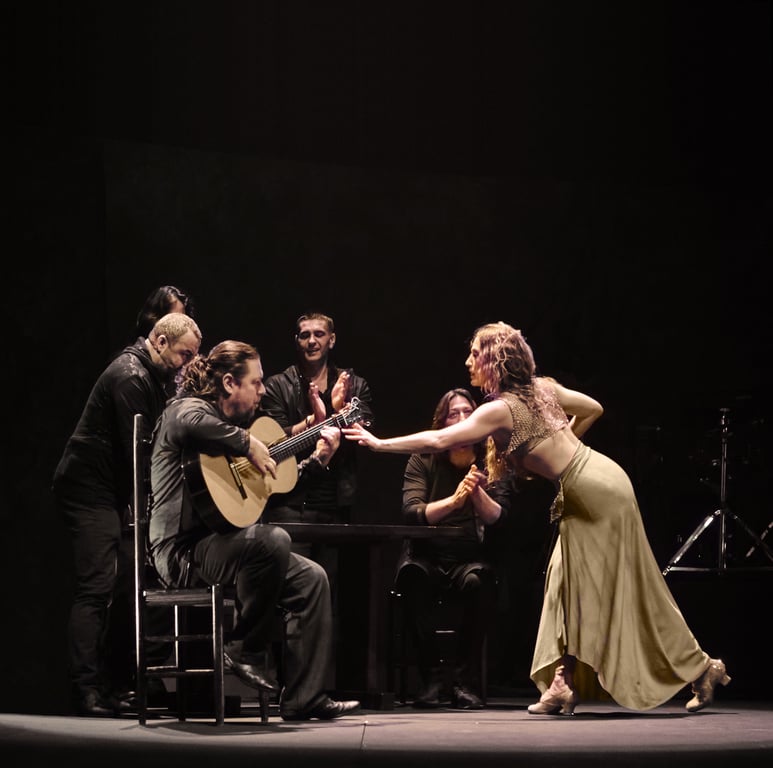
Bulerías have a special place in the shape of a flamenco evening. Traditionally, they come at the very end, in the celebratory section known as the fin de fiesta — the 'end of the party.' As a show winds toward its close, the formal structure loosens and the mood turns communal. Performers gather, the compás of bulerías takes hold, and artists step forward one at a time to dance a short, spirited passage before giving way to the next.
This ritual of taking turns is one of the most beloved moments in all of flamenco. It is generous and social, a spirit of shared celebration in which the audience, the palmas, and the artists all become part of a single festive current. If flamenco often begins in solitude and gravity, bulerías are how it chooses to end: together, and in joy.
Exhilarating, and Genuinely Demanding
For all their festivity, bulerías are among the most challenging palos to dance well — and the two facts are connected. The very qualities that make them exhilarating are what make them so demanding. The tempo is fast, the syncopation is tricky, and much of the dancing is invented on the spot rather than rehearsed.
A dancer performing bulerías must hold several things at once: staying locked to the compás, responding in real time to the singer and the guitarist, catching those off-beat accents cleanly, and doing it all while projecting the ease and joy the style demands. There is nowhere to hide in bulerías — the speed exposes any hesitation — yet the reward is a feeling of freedom and flight that few other palos can match. That balance of rigorous compás and open improvisation is exactly why dancers love them and why they take years to inhabit fully.
Learning to Feel the Bulerías
The best way to understand bulerías is not to read about them but to move with them — to feel how the twelve-beat cycle turns, where the accents want to fall, and how the phrasing pulls you forward. Start by listening and clapping palmas along with recordings until the fast compás begins to feel less like a puzzle and more like a pulse you can ride.
When you are ready to take the next step, explore Siudy Garrido's on-demand flamenco classes, which build the compás of the essential palos step by step, and browse more guides on our flamenco blog. Bulerías are the sound of flamenco celebrating itself — and once the rhythm gets into you, it is hard to sit still.
Frequently asked questions
What are bulerías in flamenco?
What is the compás of bulerías?
Why are bulerías so hard to dance?
When are bulerías performed?
Start dancing flamenco with Siudy Garrido
On-Demand Flamenco Courses — professional instruction, at your pace.
Explore Courses →