What Is Zambra? The Flamenco of Granada's Sacromonte Caves
 Part of our guide
The Palos of Flamenco: A Guide to the Styles and Forms →
Part of our guide
The Palos of Flamenco: A Guide to the Styles and Forms →
Among the many forms that make up flamenco, few carry as vivid a sense of place as the zambra. To ask what zambra is, is to be led into the hillside caves of a single Granada neighborhood, and into a history where Arab, Roma, and Andalusian traditions meet. This guide explains where the form comes from, how it survived, and why it occupies such a distinctive corner of the flamenco world.
What Is Zambra? A Flamenco Form from Granada
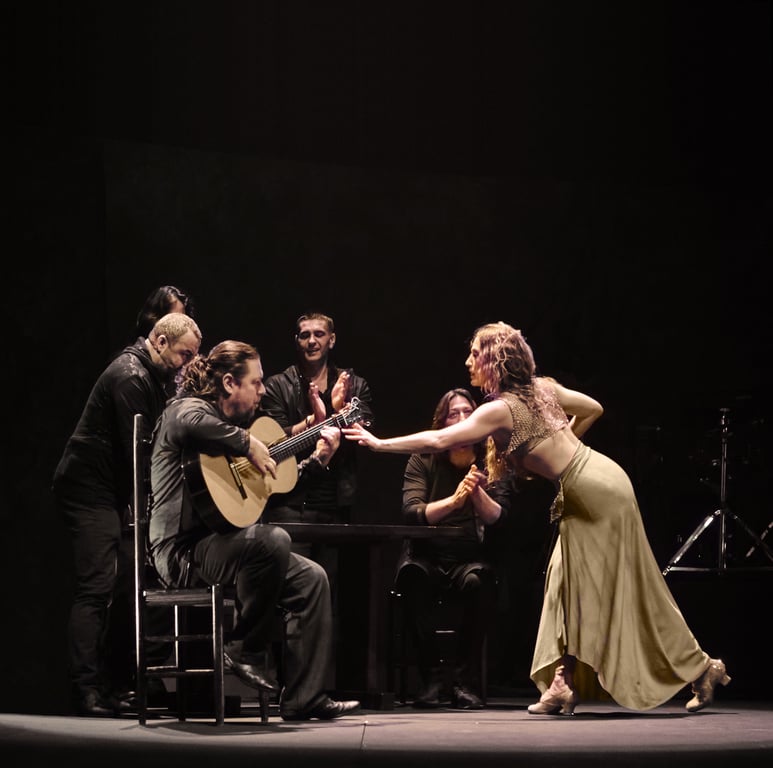
The zambra is a flamenco dance and music associated with the Romani, or Gypsy, communities of Sacromonte, a hillside quarter of Granada in southern Spain. It emerged in the sixteenth century and stands out within flamenco for its unusually direct fusion of Arab, Roma, and Andalusian influences. Where many flamenco styles trace their character chiefly to Andalusian folk song and Roma expression, zambra wears its Moorish inheritance openly, and that inheritance begins with its very name.
The word zambra derives from Arabic. That single fact is a useful key to the whole form: it points back to the centuries when Granada was the last Muslim kingdom on the Iberian Peninsula, and to the cultural layers that remained long after political power changed hands. As part of the broader family of flamenco styles, or palos of flamenco, zambra is a reminder that these forms are not uniform but each rooted in a particular history and geography.
Moorish Roots and the Moriscos
To understand zambra, it helps to look at Granada in the sixteenth century. The form evolved from Moorish dances that were preserved by the Moriscos — the Muslim population of Spain who remained after the Christian reconquest of Granada and were, at least outwardly, converted to Christianity. Within these communities, older musical and choreographic traditions were kept alive, carrying melodies and movement that had far deeper roots in the Arab world.
Over time, this inheritance passed to the Romani (Gypsy) families who settled in Granada. The two currents did not simply sit side by side; they blended. The Arab and North African character preserved by the Moriscos combined with Roma expressiveness and with the surrounding Andalusian folk tradition, and out of that meeting a distinct form began to take shape. This is why zambra is best described not as an invention but as a fusion — a pattern that runs through flamenco as a whole, and one we explore when we ask whether flamenco is Spanish or Gypsy.
Ready to put this into practice?
Train with Siudy Garrido through our On-Demand Flamenco Courses — structured, professional flamenco instruction you can start today.
The Caves of Sacromonte
No account of zambra is complete without its home. The form is inseparable from the cave dwellings of Sacromonte, the hillside on the edge of Granada where Romani families made their homes and sustained their music and dance across generations. The caves are not incidental to the story; they are where the tradition was carried, rehearsed, and handed down.
That continuity was not always easy. Zambra endured despite historical bans, periods in which the authorities sought to suppress the dances and customs of these communities. That the form survived at all owes much to the resilience of the families who kept it within the caves, out of sight and yet alive. The Sacromonte cave-zambra tradition — the practice of performing the form in these very dwellings — remains the setting most closely bound up with zambra's identity, and it is one of the clearest illustrations of how flamenco has often been preserved in the margins rather than on grand stages.
A Fusion of Arab, Roma, and Andalusian Influences
What makes zambra distinctive is precisely the way these three threads are woven together. From the Arab world, by way of the Moriscos, come melodic and gestural qualities that reach back to the region's Muslim past. From the Roma comes the expressive intensity and rhythmic feeling that shapes so much of flamenco. And from the surrounding Andalusian culture comes the wider musical setting in which the form matured. Zambra is the point where all three converge.
Seen this way, zambra is a small mirror of flamenco's larger story. The art as a whole grew over centuries as a meeting of Andalusian folklore, Moorish and Arabic melodies, Roma rhythm and voice, and other influences besides. Zambra simply makes that layering unusually visible, its Granada setting and Arabic name keeping the Moorish thread close to the surface. For the fuller arc of how these elements came together across Spain, our guide to the history of flamenco traces the journey in detail.
Zambra's Place in Flamenco Today
Zambra occupies a particular niche within the flamenco tradition: a form tied to one city, one hillside, and one community, yet part of a much larger art. It is a valuable reminder that flamenco is not a single sound but a family of forms, each carrying its own history of migration, survival, and exchange. To learn about zambra is to appreciate how geography and community shape an art, and how a name in one language can preserve the memory of a whole culture.
If the roots and regional character of forms like zambra draw you toward the art itself, the next step is to study how flamenco is built — its rhythm, posture, and movement — from the ground up. Explore on-demand flamenco classes with two-time Latin Grammy–nominated artist Siudy Garrido, or browse more on the culture and history of the art across our flamenco blog. The more you understand where each form comes from, the more richly flamenco speaks.
Frequently asked questions
What is zambra in flamenco?
Where does the word zambra come from?
Where is zambra performed?
How is zambra related to Moorish dance?
Start dancing flamenco with Siudy Garrido
On-Demand Flamenco Courses — professional instruction, at your pace.
Explore Courses →